Ontario's Plain-English Guide to Custom Home Building📞 705-533-1633 | ☎️ 1-866-868-6606 | ✉️ info@icfhome.ca

Ontario Roofing Material Calculator
Ontario – materials + budget
Bundles, rolls, pieces, boxes
2026 pricing
Roofing Material Calculator (Ontario, 2026)
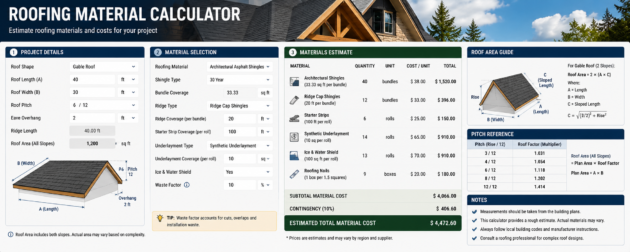
Roofing estimates go sideways when someone forgets the boring parts: starter strip, ridge-cap coverage, drip edge, ice and water, valleys, and nails. This calculator turns your roof measurements into a full materials list and a budget-level materials total – shingles, underlayment, edge metal, ridge vent, fasteners, and an optional deck-replacement allowance – so you order smart and skip the “we’re short one roll” moment on the roof.
1Shingles + bundles
2Starter, ridge, drip
3Ice and water
4Editable 2026 prices
Roofing material calculator
Enter your roof, tweak the unit prices to match your supplier, and get a materials list plus a budget total. Planning estimate only – final quantities follow the shingle manufacturer’s spec and your inspector.
Roof size
If you measured the sloped roof area already, choose Yes. Otherwise use the plan-view footprint plus pitch.
Plan-view area, not sloped. We multiply by the pitch factor to estimate the real surface area.
Pitch factor = square root of (1 + (rise/run) squared). It converts footprint to sloped area.
Use this for complex roofs where you already measured the sloped surface.
Simple gable: 8 to 10%. Cut-up roofs with valleys and dormers: 12 to 18%.
Affects the nail estimate only. Always follow the manufacturer’s spec.
Edges and lines
Starter, drip edge, and ice and water at the eaves.
Gable edges. Hip roofs may be near zero.
Ridge cap and ridge vent.
Leave 0 for gable roofs.
Valley metal and membrane allowance.
Ridge vent needs matching intake (soffits) to work.
Simple estimate. The real requirement depends on overhang and the interior wall line.
Adds a valley membrane allowance for budgeting.
Unit prices (editable, 2026 defaults)
Set to your supplier. Default coverage is beside it.
Common architecturals are ~33.3 sq ft/bundle (3 bundles = 1 square).
A 10-square synthetic roll is ~1,000 sq ft.
A 3 ft x 66 ft roll is ~200 sq ft.
Optional: deck replacement allowance
Useful for budgeting when you will not know the deck condition until you strip the roof.
Percent of base roof area, before waste.
Set to the OSB or plywood price you are seeing today.
What drives roofing quantities (the stuff people forget)
Most quick quotes only look at roof area. But your materials list swings hard on the edges and lines: eaves and rakes drive starter and drip edge, ridges and hips drive cap, valleys drive both metal and membrane, and your waste factor climbs fast once the roof gets chopped up with dormers and multiple planes.
In Ontario, do not skip ice-dam protection. Whether it is one course or two at the eaves, that leak-barrier membrane can be the difference between a clean estimate and a “why are we $600 over?” conversation. For context, a new asphalt-shingle roof in Ontario runs roughly $4.50 to $7.50 per square foot installed in 2026, so the material portion this calculator estimates is only part of the total once labour, tear-off, and disposal are added.
Reading the result: “squares” is the roofing unit – one square covers 100 sq ft. Three bundles of architectural shingles make one square. The calculator adds your waste percentage on top, then rounds each material up to whole bundles, rolls, pieces, and boxes, because that is how you actually buy them.
Building a new home and want the roof handled as part of the whole build?
We design and build custom ICF homes across Simcoe County and Georgian Bay, foundation to finish – roof included – with clean scopes and trades who show up. Tell us about your build and we will scope it end to end. No charge to ask.
Budgeting the whole build, not just the roof? Two books that pay for themselves
The roof is one line in a much bigger budget. These plan the land and the permit so nothing catches you off guard. Each $29.99, or both for $49.99.
Start here
The Ontario Lot-Buying Bible
Budget the whole build, top to bottom.
$200+ of pro advice$29.99one-time
A 28-page step-by-step that budgets the build the way the money flows – land, site, foundation, envelope, roof, hard and soft costs, and a real contingency – so you see the whole picture, not just one trade.
- Site-work and foundation cost planners
- The hard-cost / soft-cost / contingency worksheet
- The 10-minute go/no-go lot test and printable scorecard
- Bonus chapters: DIY trades, wells, easements, negotiation
30-day money-back guarantee.
Get the Lot Bible – $29.99 →
Secure checkout – download in 2 minutes – yours forever
Then run the permit
The Ontario Building Permit Bible
Permits, inspections, and the order of operations.
$10,000$29.99one-time
Everything a builder does to run a permit and pass inspections – the complete-application checklist, the inspection sequence, real 2026 fees, and how to never fail an inspection.
- The complete-application checklist, so the file does not bounce
- The full inspection sequence, stage by stage
- Real 2026 permit fees and what triggers them
- How to never fail an inspection – and the costliest mistakes
30-day money-back guarantee.
Get the Permit Bible – $29.99 →
Secure checkout – download in 2 minutes – yours forever
Building the whole thing? Get both Bibles.
Budget the land and the build, then run every permit and inspection without the guesswork.
$59.98 Both for $49.99
Get both Bibles →
Roofing material calculator: frequently asked questions
How many bundles of shingles are in a square?
Most architectural (laminate) shingles are 3 bundles per square, and a square covers 100 sq ft. That is why the default coverage is about 33.3 sq ft per bundle. Three-tab shingles can differ, so confirm the coverage printed on your specific product’s wrapper and enter it in the calculator.
Footprint area or roof surface area – which do I enter?
If you only have the plan-view footprint (the area of the building outline), enter it and pick your pitch – the calculator multiplies by the pitch factor (square root of 1 plus rise-over-run squared) to estimate the real sloped area. If you already measured the sloped surface, switch the first question to Yes and enter it directly. A steeper roof has more surface area than its footprint, which is exactly what the pitch factor accounts for.
What waste percentage should I use?
Simple gable roofs usually land around 8 to 10%. Cut-up roofs with valleys, dormers, hips, and multiple planes commonly run 12 to 18%, because more cuts mean more offcuts. Starter and cap are estimated separately, so the waste percentage mainly affects field shingles, underlayment, and nails.
Do I really need starter strip and ridge cap?
Yes. Starter strip gives you the correct sealed edge at the eaves and rakes and resists blow-off, and ridge cap finishes the ridges and hips. Using cut-up field shingles instead of proper starter and cap is a common shortcut that shows up later as lifted edges and leaks. Most manufacturers require both for the warranty.
Is ridge vent always a good idea?
Ridge vent works well only if you also have adequate intake, usually at the soffits. Exhaust without matching intake does not move air – it just makes a fancy slot. Balanced intake and exhaust is what actually ventilates the attic and helps control ice dams and summer heat. If your soffits are blocked or missing, fix the intake before counting on the ridge vent.
Why estimate ice and water by eave length times depth?
It is a fast budgeting method: you are covering a strip along the eaves, so length times the depth of coverage gives the area, which the calculator divides by the roll size. Real requirements can be more specific – measured from the roof edge to a point past the interior wall line, plus valleys and penetrations – so treat this as an ordering and cost-planning number and confirm the exact layout on site.
Does this include labour, tear-off, and tax?
No. This is a materials-only, budget-level estimate. It does not include labour, tear-off and disposal, flashing details, permits, or HST. For context, a new asphalt-shingle roof in Ontario runs roughly $4.50 to $7.50 per square foot installed in 2026, so materials are only part of the full job. Get quotes from licensed roofers for the installed price.
How accurate is the result?
It is a solid planning and ordering estimate when your measurements and prices are good. Every quantity rounds up to whole units because that is how materials are sold, and the defaults reflect 2026 Ontario pricing you can edit to your supplier. Final quantities still depend on the shingle manufacturer’s spec, your roof geometry, flashing details, and local inspection requirements.
Estimating disclaimer: this tool is for ordering and budget planning only. Final quantities depend on manufacturer instructions, flashing details, roof geometry, and site conditions. Always follow the shingle system spec for eaves, valleys, and fasteners, and confirm requirements with your supplier and local building department.
Related guides
More calculators
Latest posts
Fresh guides, calculators & real-world advice
More from BuildersOntario – scroll to explore.
Loading latest posts…
Tip: shift + mousewheel works great
Roofing Questions People Ask All the Time
Homeowners want to avoid leaks and surprise bills. Contractors want to avoid call-backs and failed inspections. Here are the roofing questions that come up over and over in Ontario—answered in plain English.
How do I know if I need a full roof replacement or just a repair?
If the roof is leaking from a single, obvious issue (a pipe boot, one valley, a few missing shingles), a repair can be sensible.
But if you’re seeing widespread wear, multiple leak points, or the shingles are at end-of-life, repairs become “band-aids on a tire.”
- Repair-friendly: isolated damage, recent roof, good attic ventilation, no deck rot.
- Replace-friendly: lots of granule loss, curling, repeated leaks, soft decking, or multiple layers.
Tip: If you’re paying for the same leak twice, it’s not a “repair”… it’s a roof asking for retirement.
How long should asphalt shingles last in Ontario weather?
“Lifetime” is marketing. Real life depends on ventilation, sun exposure, slope, installation quality, and storm cycles.
- 3-tab: typically shorter service life.
- Architectural/laminate: generally longer and more wind-resistant.
- Bad ventilation can shorten lifespan fast (heat cooks shingles from underneath).
Rule of thumb: The roof system (venting + flashing + deck condition) matters as much as the shingle brand.
What are the early warning signs of roof failure (even if it “looks fine”)?
Many roofs fail from details—not from the big open field of shingles.
- Granules in gutters / at downspouts
- Shingle edges curling, cracking, or lifting
- Rusty nails in attic, moldy sheathing, damp insulation
- Stains around chimneys, skylights, valleys, and bathroom fans
Tip: The attic tells the truth. The roof surface often lies.
What causes leaks the most: shingles, flashing, valleys, skylights, or vents?
Leaks usually start at transitions—anywhere the roof changes direction or gets penetrated.
- #1 suspects: step flashing at walls, chimney flashing, plumbing boots, skylight curbs
- Next up: valleys (heavy water flow), missing/incorrect drip edge, poor underlayment laps
Field shingles are the easy part. Details are where the money (and headaches) live.
What’s the best way to prevent ice dams and winter leaks?
Ice dams are usually a heat-loss + ventilation problem, not a “bad shingle” problem.
- Air-seal the attic plane (stop warm air leakage)
- Increase attic insulation (reduce roof melting)
- Ensure continuous soffit intake + exhaust (ridge/vents)
- Use proper eave protection membrane (ice & water)
Tip: If your attic is warm in January, your roof is doing double duty as a space heater.
Do I really need ice & water shield — and how far up the roof does it go?
In Ontario, eave protection is often required for heated roofs and is cheap insurance against ice dam backup.
- Typical installs are one course (3 ft) or two courses (6 ft) at eaves
- Valleys and penetrations often get membrane too
Always follow local inspector expectations and the shingle manufacturer’s details.
Should I install ridge vent, roof vents, or gable vents—and what happens if it’s “unbalanced”?
Balanced ventilation means you have enough intake (soffit) to feed your exhaust (ridge/roof vents).
If you only add exhaust, the attic will try to “pull” air from wherever it can—often from the house.
- Best: soffit intake + ridge exhaust
- Watch out: mixing ridge vents with large gable vents can short-circuit airflow
What’s the difference between 3-tab and architectural shingles?
Architectural shingles are thicker, more dimensional, and typically offer better wind performance and longer real-world lifespan.
3-tab is cheaper upfront but often loses the long game.
- Architectural: better look, heavier, usually stronger
- 3-tab: budget choice, less forgiving in storms
How do you estimate bundles/squares and waste so you don’t run short?
Roofing is sold in squares (100 sq.ft.) and bundles. Waste depends on roof complexity.
- Simple gable: 8–10% waste
- Hip/cut-up: 12–18% waste
- Don’t forget caps, starter, valleys, and edge metal—those aren’t “included.”
Can new shingles go over old shingles, or should everything be stripped?
You can sometimes re-roof over an existing layer, but it’s often a false economy.
Stripping lets you inspect the deck, fix rot, and install proper underlayment and details.
- Overlay risks: hides deck issues, adds weight, can worsen ventilation, messy lines at edges
- Best practice: strip when the roof is old, uneven, leaking, or you want it done once.
Do I need drip edge—and does it go under or over the underlayment?
Drip edge protects the deck edge and fascia from water tracking back under shingles.
Where it goes depends on the edge:
- Eaves: commonly drip edge goes under underlayment
- Rakes: commonly drip edge goes over underlayment
Follow the manufacturer detail package and local practice—this is a small detail with a big payoff.
What’s the “right” roof pitch for shingles—and what changes on low-slope roofs?
Shingles need slope to shed water properly. On lower slopes, you may need special underlayment practices
(and sometimes shingles aren’t the best roof covering at all).
- Low slopes are more vulnerable to wind-driven rain and ice backup.
- Always check the shingle product’s minimum slope requirement.
Which underlayment should I use: synthetic vs felt?
Synthetic underlayments are lighter, stronger, and often safer to walk on. Felt is cheaper but tears easier and wrinkles more.
- Synthetic: better tear resistance, longer exposure ratings, consistent coverage
- Felt: budget-friendly, but more sensitive to moisture and wrinkles
When is ice & water required, and how should it be used at valleys/eaves/penetrations?
Treat membrane like the roof’s “seatbelt.” It’s not the whole system, but when something goes wrong, you’ll be glad it’s there.
- Eaves: protects against ice dam backup
- Valleys: common to membrane the valley before metal/shingles
- Penetrations: proper boots/flashing first, membrane as backup detail
How should valley flashing be detailed: open vs closed valley?
Open valleys shed water fast and are easy to inspect. Closed valleys can look cleaner but are pickier to install correctly.
- Keep nails away from the valley centerline.
- Use continuous sheathing and proper valley flashing/membrane.
- In heavy snow areas, valleys deserve extra respect (and often extra protection).
What installation mistakes cause blow-offs and leaks?
The greatest hits:
- High nailing (misses the reinforced zone)
- Overdriven nails (cuts the shingle)
- Underdriven nails (holds shingle up, creates leak path)
- Poor flashing at walls/chimneys, sloppy valleys, bad vent/boot details
Tip: A roof doesn’t leak because it hates you. It leaks because someone rushed the details.
How many nails per shingle—4 vs 6—and when do I use 6?
Many standard installs are 4 nails/shingle. High-wind zones and some manufacturer requirements call for 6.
- 4 nails: typical baseline
- 6 nails: higher wind resistance (more labour + more nails)
Always follow the shingle manufacturer’s nail placement diagram.
How do I calculate ridge/hip cap bundles correctly?
Cap coverage varies by product and exposure. Don’t guess.
- Measure ridge + hips in linear feet.
- Divide by the cap product’s coverage (lin.ft./bundle) and round up.
- Factor extra if you’re using a thicker cap profile or special vented caps.
How do I estimate materials for a “cut-up” roof?
Cut-up roofs burn material in three places: waste, starter/caps, and details (valleys, walls, dormers).
- Bump waste to 12–18% depending on complexity.
- Expect higher starter and cap usage (more edges, more ridges/hips).
- Valleys can double up membrane/metal needs.
Where do code requirements end and manufacturer instructions begin—and which one wins?
- Code sets minimum safety/performance requirements.
- Manufacturer instructions protect the warranty and specify how the system must be installed.
Tip: The only thing worse than failing an inspection is “passing” and then getting a leak call-back.