Ontario's Plain-English Guide to Custom Home Building📞 705-533-1633 | ☎️ 1-866-868-6606 | ✉️ info@icfhome.ca
The Shore Road Allowance: The 66 Feet of Waterfront You May Not Own
Ontario Cottage Guide · Shoreline Ownership · Surveys
The Shore Road Allowance: The 66 Feet of Waterfront You May Not Own
On many Ontario lakes a 66-foot strip runs between the cottage lot and the water, and it belongs to the township. Here is what the shore road allowance is, how to find out if your lot has one, what it takes to buy it, and why some townships will not give you a permit until you do.
Quick truth: A listing can say waterfront. Only a survey can say you own it. Check for the shore road allowance before you buy, and long before you design.
You May Not Own the Land Your Dock Is Tied To!
Here is a conversation we have more often than you would think. The owner says, “I have a hundred feet of waterfront.” We look at the survey and say, “You have a hundred feet of frontage on a road allowance. The township has the waterfront.”
It is called the shore road allowance. On a great many Ontario lakes and rivers, a strip of land sits between the private lot and the water, and it does not belong to the cottage owner. People live beside it for fifty years without knowing. They find out when they try to sell, mortgage or build.
What It Is and Why It Is There
When the Crown surveyed much of Ontario in the 1800s, the surveyors were told to leave a strip along the shores of lakes and rivers for public travel and for moving logs and goods. The strip is normally 66 feet wide, which is one surveyor’s chain, or about 20 metres.
The roads were never built. The strips are still there. In most places the municipality now owns them. In some places the strip is a Crown shoreline reserve and belongs to the Province instead.
What it means for you
- Your lot line may stop 66 feet short of the water
- The cottage, deck, boathouse or dock may sit on land you do not own
- The township can say what happens on that strip
- Lenders, insurers and buyers’ lawyers will all ask about it
What it does not mean
- It does not mean a road is coming. Nobody is paving your beach.
- It does not mean every lot has one. Many were closed and sold to owners long ago.
- Do not assume that using it for decades has made it yours. That is a question for your lawyer, not your neighbour.
How to Find Out If Your Lot Has One
- Read the survey. A proper survey shows the allowance as its own strip between your lot line and the water. Our guide on how to read an Ontario survey shows what to look for.
- Read the legal description. If a previous owner bought the allowance, the description will include it, often as a separate part on a reference plan.
- Ask the township. The clerk or planning office can tell you whether the allowance in front of your lot is still open, or was closed and sold.
- Ask your lawyer to check title. Before you buy, not after.
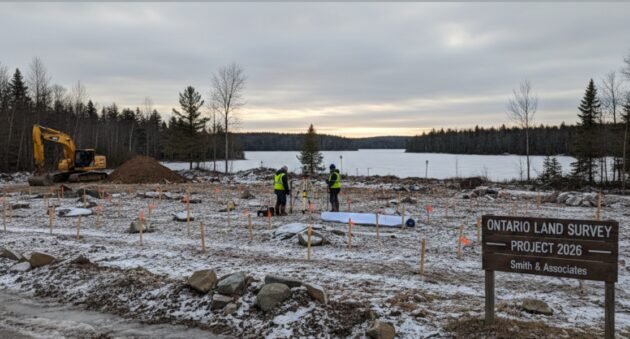
No survey, or one older than the cottage? Order a new one. It is the cheapest thing you will buy on a waterfront lot and the only thing that answers this question.
Can You Buy It?
Usually you can ask. Whether you get it is up to the township, and no council is obliged to say yes.
The process is called closing and conveying the road allowance. It runs something like this:
- You apply to the township and pay an application fee. Huntsville lists $1,187. The Township of Muskoka Lakes policy lists $1,000.
- Some townships want your neighbours’ written consent. Hastings Highlands is one.
- You pay for a reference plan from a surveyor. On shore allowances the plan often has to show the flooded and unflooded parts separately, because lake levels have changed since the 1800s.
- Council passes a by-law to close the allowance and sell it to you.
- You pay the township’s price for the land, plus its legal costs and your own.
Every township sets its own land price and its own rules, so I am not going to give you a total. Add up the application fee, the survey, two sets of legal fees and the land, and ask the township for its current schedule. Then allow months. Councils do not hurry.
Where the strip is a Crown shoreline reserve and not a municipal allowance, the application goes to the Ministry of Natural Resources. Some townships also point out that Crown land along the shore has to be dealt with before they can sell you their part.
Do You Have to Buy It Before You Build?
In some townships, yes.
- Huntsville says owners of waterfront lots with a shore road allowance who want to develop will be required to buy it as a condition of planning approval.
- Muskoka Lakes changed its policy on June 10, 2026. Boathouses are no longer exempt, and the allowance has to be owned before a building permit for a boathouse is issued. The Township offers an option to keep eligible projects moving while the purchase is in progress.
- Hastings Highlands requires you to buy the allowance before doing any improvement on it, and warns that owning it does not by itself mean you can build on it. The setback rules still apply.
That last point catches people. Buying the strip makes it yours. It does not make it buildable. The water setback is measured the same way whoever owns the ground.
What If the Cottage Is Already Sitting on It?
It happens more than anyone admits. One Ontario owner had her lot surveyed four years after buying and learned that nearly the whole cottage stood on the municipal allowance.
If that is your situation, you have two jobs, in this order. First, apply to buy the allowance, so the building stands on your own land. Second, sort out what the zoning allows, because a cottage that close to the water is almost certainly non-complying. Our page on rebuilding a cottage where it stands covers that half.
And if you are the buyer, make the offer conditional on a survey and a clear answer about the allowance. Our page on buying a waterfront lot lists the conditions worth writing in.
On Georgian Bay in Tiny Township
Many Georgian Bay lots in Tiny do not reach the water. There is often an unopened road allowance between the lot line and the beach, and it belongs to the Township unless it was closed and sold to an earlier owner. It will be on the survey. Read it before you plan anything near the water, and ask the Township where yours stands. Tiny’s shoreline rules are also under appeal right now, so this is not the year to guess.
Four Rules of Thumb
- “Waterfront” in a listing is a description, not a legal fact. The survey is the legal fact.
- Find out before you design. An allowance takes 66 feet off the depth of the lot you thought you had.
- Start the purchase early. It runs on council’s calendar, and your building permit may be waiting on it.
- Owning it changes who you ask, not what you may build.
Not Sure What You Actually Own?
ICFhome.ca builds on the Georgian Bay shore in Tiny Township and across Simcoe County, and we read a survey before we talk about a house. Send us yours and we will tell you what we see, including the things the listing left out.
Related guides on this site
Sources and further reading
Questions people ask
What is a shore road allowance?
A strip of land, normally 66 feet wide, that Crown surveyors left along the shores of many Ontario lakes and rivers in the 1800s. It sits between the private lot and the water and is usually owned by the municipality.
How do I find out if my lot has a shore road allowance?
Check the survey, which shows it as a separate strip between your lot line and the water. Then check the legal description and ask the township whether the allowance in front of your lot was ever closed and sold.
Do I own the land down to the water?
Not always. If an open shore road allowance lies in front of your lot, your ownership stops at the allowance, and the strip along the water belongs to the municipality or the Crown.
Can I buy the shore road allowance?
You can apply to the township to close it and sell it to you. Approval is at council's discretion. Expect an application fee, a surveyor's reference plan, legal costs and the township's price for the land.
What does it cost to buy a shore road allowance?
It varies by township. Application fees of about $1,000 to $1,200 are published by Muskoka Lakes and Huntsville, and on top of that come the survey, legal fees on both sides and the land itself. Ask your township for its current schedule.
What if my cottage or boathouse is already on the allowance?
Apply to buy the allowance so the building stands on your own land, then deal with the zoning, since a building that close to the water is usually non-complying.
Do I have to buy it before I can build?
In some townships, yes. Huntsville requires the purchase as a condition of planning approval, and Muskoka Lakes requires ownership before issuing a boathouse permit.
Reviewed and updated November 2026. Zoning rules are set by each municipality and change; confirm with your own township before you spend money. Costs on this site are Ontario ranges, not quotes.