Ontario's Plain-English Guide to Custom Home Building📞 705-533-1633 | ☎️ 1-866-868-6606 | ✉️ info@icfhome.ca

Helical Piles in Ontario: Cost, Permits and When They Beat Concrete (2027)
What helical (screw) piles cost in Ontario in 2027 for decks and additions, when they beat concrete footings, and the paperwork a building department wants.
Decks, additions, cottages
2027 Ontario prices
Permits and paperwork
A Helical Pile Is A Big Steel Screw. Sometimes That Is Exactly What You Need!
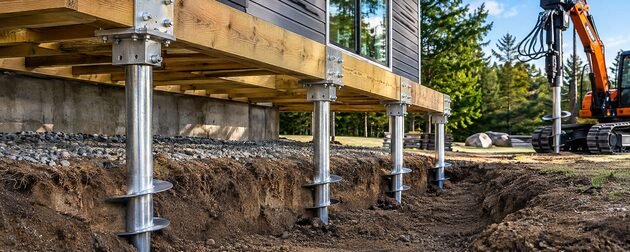
Helical piles, also sold as screw piles, get turned into the ground by a machine until they are tight. No hole, no concrete, no waiting. They are a very good answer on some sites and the wrong one on others. Here is how to tell, and what they cost in Ontario in 2027.
The short version: for a deck, expect roughly $150 to $450 per pile installed. For heavier work such as an addition or a foundation repair, $300 to $700 per pile is the usual range, plus engineering where the town asks for it. They shine in wet ground, tight yards and winter. They are stopped cold by bedrock and big boulders, which is a good part of cottage country.
Let Me Lower Your Expectations First
The sales pitch is that a pile takes half an hour and you can frame on it the same day. That part is true, and after you have dug and poured a dozen deck footings by hand it sounds like a miracle.
What the pitch leaves out is that a pile only works if it reaches soil that can carry the load, and nobody knows for certain what is down there until the machine is turning. On good ground it goes in like a screw into pine. On the Canadian Shield it stops at eighteen inches and stares at you.
I pour concrete foundations for a living, so take my view of steel piles with that in mind. I still use them where they make sense.
How They Work
A pile is a steel shaft with one or more screw plates, called helices, welded near the tip. A hydraulic drive head on a small machine turns it into the ground. The installer watches the torque, which is how hard the machine is working to turn it.
That torque reading is the whole point. The harder the pile is to turn, the more load the soil around it can carry, and the manufacturer’s engineering ties one number to the other. A proper install ends with a record of the torque and depth of every pile. That sheet is what the building department wants to see.
The pile goes down past the frost line, so frost has a slim steel shaft to grab instead of a wide concrete footing. A bracket on top takes the post or beam.
What Helical Piles Cost In Ontario, 2027
The contractors and price guides we looked at quote widely different prices, mostly because a deck pile and a pile under a house are very different pieces of steel. Use these as planning ranges.
| Job | Typical 2027 range | Notes |
|---|---|---|
| Deck pile, installed | $150 to $450 per pile | Light loads, good access. A 300 sq ft deck often takes about 8 piles. |
| Pile for an addition, cottage or foundation repair | $300 to $700 per pile | Bigger shafts and helices, deeper installs. Tight city sites run higher. |
| Engineer’s letter or stamped drawings, where required | $500 to $1,200 | Depends on the municipality and the job. |
Ranges gathered from Ontario installer and price-guide pages published in 2025 and 2026.
For a small deck, piles usually cost more than concrete tubes in materials and come out about even once you count the digging, the concrete, the wait and the mess. Run your own numbers with the concrete footings cost calculator and compare.
Where They Beat Concrete, And Where They Do Not
| Piles are a good idea when | Stay with concrete when |
|---|---|
| The water table is high and a footing hole fills with water as fast as you dig it. | There is bedrock or heavy boulders near the surface. The pile cannot get to depth. |
| You cannot get a truck or an excavator into the back yard. | The ground is already open for a foundation, and concrete is on site anyway. |
| It is winter and you do not want to heat and protect fresh concrete. | The structure needs a full frost wall, a crawl space or a basement. |
| You want to disturb as little of the yard, the roots or the shoreline as possible. | Nobody local installs them with proper engineering behind the product. |
| The soil is soft near the surface and firm lower down. | The piles would stand tall out of the ground with nothing bracing them sideways. |
That last one catches people. A pile is strong straight down. A tall deck on slim steel shafts needs bracing against sway, the same as a deck on tall wood posts. See deck framing for how that is done.
Not sure what is under your lot? Building lot soil conditions in Ontario is the place to start, and for a house or an addition the full comparison is on foundation types.
Permits And Paperwork
The Building Code’s housing rules describe concrete footings in detail. A helical pile is a manufactured, engineered product, so the building department wants proof that it does what a footing would. Before you hire anyone, ask the town which of these they need:
- The product’s evaluation. Established pile makers have a Canadian evaluation report for their system. Ask the installer for it.
- A layout. How many piles, where, and what load each one carries.
- An engineer’s letter or stamp. Some municipalities accept the manufacturer’s engineering for a simple deck. Others want a stamped drawing for every job.
- The installation record. Torque and depth for each pile, signed by the installer.
The deck or addition sitting on the piles still needs its own permit where one is required. Start with building a deck in Ontario.
Rule of thumb
No torque record, no pile. If the installer cannot tell you what each pile was driven to and hand you the sheet, you have bought a steel post in a hole, and so has your inspector.
Where Homeowners Go Wrong!
- They count piles off a concrete footing plan. Piles carry different loads than tubes. The spacing comes from the pile’s rating and your beam, not from the last deck you built.
- They hire the machine, not the system. Anyone can buy a drive head. Ask whose piles they are, and whether the engineering covers Ontario.
- They forget the locates. A pile going through a gas line or a septic bed is a very bad day. Call for locates, and know where your tank and bed are.
- They skip the permit because there is no concrete. The permit is for the structure, not the footing.
- They use them to lift a cottage without a plan. Raising a building is its own job. See raising a cottage and putting a foundation under it.
Questions I Get Asked
Are helical piles allowed for a deck in Ontario?
Yes, they are widely accepted. What varies is the paperwork. Some building departments take the manufacturer’s engineering for a simple deck and others want an engineer’s stamp. Ask before you book the installer.
How long do they last?
The piles are galvanized steel and makers quote long service lives in normal soil. Aggressive soils and salt shorten that. Ask the supplier what their evaluation says about your conditions.
Can a house sit on helical piles?
Additions, cottages and small buildings are built on them, and they are also used to shore up settling footings. For anything carrying a house, an engineer designs it. That is not a catalogue job.
What if a pile hits a rock?
The installer may shift it a short distance and try again, which can change the framing above. If rock is everywhere, the right answer is usually a footing pinned to the rock, not a pile.
Sources And Further Reading
- 2024 Ontario Building Code Compendium, Part 9: the footing and foundation depth rules a pile has to stand in for.
- Professional Engineers Ontario, to confirm an engineer is licensed.
Floor joist and beam span tablesHow far joists and built-up beams can span, with a calculator.Retaining wallsWhen a wall needs a permit and an engineer, and what it costs.Foundation cracksWhich cracks matter, who to call and what repairs cost.Basement underpinningLowering a basement: methods, permits and cost.Lintel and header span tablesWhat size header goes over a window or door.Do I need a structural engineer?When a house job needs a stamp, and what that costs.
Ask The Town Before You Ask For Quotes
Find out what your building department wants to see for helical piles. Then ask each installer to price the job with that paperwork included. It is the only fair way to compare a pile quote with a concrete one.
Information only. Not engineering advice. Pile capacity depends on the product, the soil and the installation; confirm requirements with your building department.
Building or rebuilding a cottage? Related guides: building on bedrock. Start with the Ontario cottage building guide.