Ontario's Plain-English Guide to Custom Home Building📞 705-533-1633 | ☎️ 1-866-868-6606 | ✉️ info@icfhome.ca
Owner-Builder Ontario: What You Can (and Can’t) Do Yourself
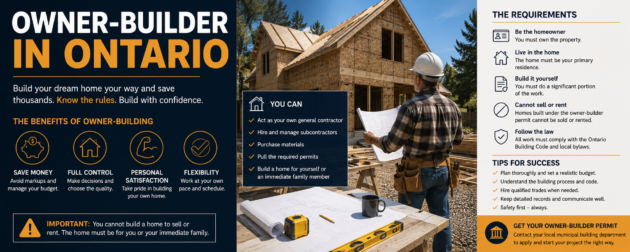
Owner-builder
What you can DIY
And the one thing you can’t
Owner-Builder Ontario: What You Can (and Can’t) Do Yourself
On a home you own and live in, Ontario lets you do far more yourself than people think – design your own plans, design and install your own septic, wire it, plumb it, and run the non-gas parts of the heating. The rule of thumb is simple: pull the permit, pass the inspection, and you can self-perform most of it. There is exactly one hard line that never bends – gas – and one trap most owner-builders miss: Tarion. Here is the honest, trade-by-trade breakdown from a builder who has worked alongside a lot of owner-builders across Simcoe County and Georgian Bay for 45 years.
The owner-builder’s roadmap
Self-perform the work with the step-by-step PDF, or hand us the parts you’d rather not touch. Most owner-builders do both.
Best value – the $10,000 builder roadmap
The Ontario Building Permit Bible
Be your own general contractor – without the guesswork.
$10,000$29.99one-time
Everything a builder does to coordinate a build – the permits, the order to hire trades, the inspections – in one plain-English playbook. Built for owner-builders.
- Every permit you need and who pulls it – building, ESA, plumbing, septic, gas
- What you can self-perform, and the order to do it in
- The complete-application checklist, so the permit does not get bounced
- How to never fail an inspection – and the mistakes that cost the most
30-day money-back guarantee.
Get instant access – $29.99 →
Secure checkout – download in 2 minutes – yours forever
Done for you
We’ll handle the hard parts
Drawings, heat-loss, septic design, or the whole build.
Do the labour yourself and hand us the technical pieces – the permit-ready drawings, the stamped heat-loss, the septic design – or have us build it Tarion-backed. Anywhere in Ontario.
- Permit-ready drawings by a BCIN designer; engineering arranged
- BCIN-stamped CSA F280 heat-loss and SB-12 energy package
- Septic design, and sitework for the pad, grading, and bed
- 45 years, 300-plus homes – the parts that are worth not guessing on
Free quote, no obligation.
A real person gets back to you within one business day
Hit a Code question while doing it yourself?
Self-performing means you are the one who has to meet the Code. Ask our OBC Code Navigator your exact question – the first two are free, and you can grab the OBC PDF there too. Faster than reading 800 pages to find one clause.
The one-line rule
On a home you own and live in, Ontario lets you self-perform most of the work – as long as you pull the permit and pass the inspections. The magic phrase is “your own home you own and reside in.” It does not extend to rentals, cottages you do not live in, or someone else’s property – those need licensed trades. And it does not lower the standard: the work still has to meet the Code, and the inspector still has to sign off.
The hard line that never bends: GAS. All gas piping, and connecting or commissioning any gas appliance – furnace, boiler, water heater, fireplace – must be done by a TSSA-certified gas technician. There is no homeowner gas exemption in Ontario. Everything else below has a DIY path; gas does not.
Trade by trade: what you can self-perform
YES – your own home
Design and draw your own plans
The Building Code exempts an owner from designer (BCIN) registration when the design is for their own home – you declare the exemption on the permit application. Many municipalities also accept owner-prepared drawings for simpler work. The catch: the drawings still have to be scaled, complete, and code-compliant, and structural elements (beams, big openings, odd foundations) usually still need a Professional Engineer’s stamp. Small and simple, draw it yourself; a new custom home is doable but a lot of work. See what permit drawings need to show.
Rather not draft it? We draw permit-ready sets for owner-builders –
YES – on your property
Design and install your own septic
Under Building Code Part 8 (on-site sewage under 10,000 L/day), the property owner may both design and install their own septic system on that property – and the owner designing their own system is exempt from designer registration. Anyone else who designs or installs it must be a qualified, registered (BCIN) installer. A permit is still required before you start, and the system is inspected – the issuer may be the municipality, the local health unit, or the conservation authority. Designing a septic right (soils, percolation, setbacks to wells and water, bed sizing) is technical, and getting it wrong is buried and expensive. See septic systems in Ontario.
Want it designed right? We do septic design, and Georgian Bay Siteworks handles the excavation and bed –
YES – principal residence
Wire your own house
You may do the electrical work on the home you own and live in – but you must file an ESA notification of work (the permit) before you start, even for small jobs, and the work is inspected. Pass, and you get an ESA Certificate of Inspection – keep it with your house records, because it is what insurers and buyers ask for. This does not apply to rentals or cottages you do not live in; those need a Licensed Electrical Contractor. Ontario is on the 2024 Electrical Safety Code (in force since May 1, 2025).
YES – own + reside + self-perform
Do your own plumbing
You can work on your own plumbing if you own the home, live in it, and do the work yourself. Minor repairs – fixing a leak, swapping a faucet like-for-like, clearing a drain – generally need no permit. Altering or extending the system, moving fixtures, or new water and sewer lines need a permit. You cannot do it if you are not on title, or in a shared building (condo/apartment) where the work affects other units – then a licensed contractor is required.
YES – except gas
Install your own heating (the non-gas parts)
On your own home, under a building permit, you can generally install the mechanical, non-gas side yourself: ductwork, hydronic and in-floor tubing, manifolds, pumps, and the heating distribution. A new hydronic system needs a permit and must comply with CSA B214, and the design has to be documented. Electric and heat-pump heat sources keep you clear of the gas technician (but still need ESA for the electrical). What you cannot DIY: the gas. See the radiant and heating guides on radiant floor heating.
Gas stays with TSSA: the gas line and connecting the furnace, boiler, or water heater must be a TSSA-certified technician. You can run the tubing and ducts; you cannot make the gas connection.
TECHNICALLY yes, but…
Can you do your own heat-loss (CSA F280)?
A new-home permit needs a CSA F280-12 heat-loss / heat-gain calculation (OBC 9.33.2.2), and the owner-design exemption can, in some circumstances, extend to it. But practically, almost no owner-builder does their own: it normally has to be produced in CSA-approved software and stamped by a BCIN designer in the HVAC-House category, with the BCIN on every page, and most building departments expect a stamped calc. Even owners who draw, wire, and plumb their own house usually just buy a stamped F280 – it is cheap relative to the build and removes a common deficiency.
The easy route: a BCIN-stamped CSA F280 in about 48 hours from OntarioHeatLoss.ca.
Owner-building and want a second opinion before you commit?
“Am I about to make an expensive mistake?” is the cheapest call you can make. We will go through your plan – what you will self-perform, what to hand off, the permits in what order, and the lot’s gotchas – so you go in with eyes open. Quick paid consult: we scope it on a call and send a secure payment link, so you only pay once you know what you are getting.
The owner-builder trap most people miss: Tarion
This is the one that catches people, and it has nothing to do with the trades. To build your own home in Ontario you must first get a Letter of Confirmation from Tarion before you start. Owner-built homes are not enrolled with Tarion and carry no statutory new-home warranty – if you take significant control of the build (hiring your own trades and suppliers), the project does not qualify for Tarion coverage, and your warranties come straight from the trades and suppliers instead.
The big one: if you sell the home without first genuinely living in it, you are required to register with Tarion and enrol the home. Fail to, and you can face prosecution and significant fines. The HCRA licenses professional builders; the owner-builder is the carve-out, and it comes with these strings. Plan for it before you start, not at sale.
None of this means do not owner-build – plenty of people do it well. It means going in clear-eyed: you are now the general contractor, the coordinator, and the warranty. If at any point you would rather have the certainty of a Tarion-backed build, that is what we do – and you can hand off as much or as little as you want.
What you still can’t DIY (the firm limits)
- Gas – lines and appliance connections, TSSA-certified only. No exception.
- Work on a home you don’t own or don’t live in – rental, cottage, someone else’s – licensed trades.
- Condo or shared-building work affecting other units – a licensed contractor is required.
- Skipping the permit or the inspections – never legal, and it can void your insurance. Here is what happens if you build without a permit.
- Engineering the structure where the build needs it – that is a P.Eng. stamp, not a homeowner declaration.
Note on compulsory trades: electrician, plumber, sheet-metal, and gas technician are regulated trades, and paid work generally needs the licence. The homeowner-on-own-home carve-outs above (ESA-permitted electrical; plumbing if you own, reside, and self-perform) are the exceptions – and gas has no homeowner exception at all.
Related guides on this site
Owner-builder Ontario: frequently asked questions
Can I build my own house in Ontario?
Yes. On a home you own and will live in, Ontario lets you act as your own builder and self-perform much of the work, provided you pull the permits and pass the inspections. You must first get a Letter of Confirmation from Tarion before you start. Be aware that an owner-built home is not enrolled with Tarion and has no statutory new-home warranty, and that you are taking on the role of general contractor, coordinator, and warranty. Plenty of people do it well – the key is going in clear-eyed about what you are responsible for.
Can I draw my own house plans for a permit in Ontario?
For your own home, generally yes – the Building Code exempts an owner from designer (BCIN) registration when designing their own home, and you declare the exemption on the application. The drawings still have to be scaled, complete, and code-compliant, and structural elements usually still need a Professional Engineer’s stamp. Simple projects are realistic to draw yourself; a full custom home is doable but a lot of work, and a missing detail bounces the same as anyone’s.
Can I design and install my own septic system in Ontario?
Yes – under Building Code Part 8, the property owner may both design and install their own on-site septic system (under 10,000 L/day) on that property, and the owner designing their own system is exempt from designer registration. Anyone else doing it must be a qualified, registered installer. A permit and inspections are still required, issued by the municipality, the health unit, or the conservation authority depending on your area. Designing it correctly is technical, so many owners design it with help even when they install it themselves.
Can I wire my own house in Ontario?
Yes, on the home you own and live in – but you must file an ESA notification of work before you start, even for small jobs, and the work is inspected, ending in a Certificate of Inspection you should keep permanently. It does not apply to rentals or cottages you do not live in, which need a Licensed Electrical Contractor. The ESA permit and inspection are mandatory; doing electrical work without them is both unsafe and a problem for insurance and resale.
Can I do my own plumbing and heating?
Plumbing: yes, on a home you own, reside in, and work on yourself – minor repairs usually need no permit, while altering or extending the system does. Heating: you can install the non-gas mechanical side yourself – ductwork, hydronic and in-floor tubing, distribution – under a building permit, and a new hydronic system must comply with CSA B214. The one thing you cannot do is the gas: all gas piping and connecting a furnace, boiler, or water heater must be a TSSA-certified technician. There is no homeowner gas exemption in Ontario.
Can a homeowner do their own gas work in Ontario?
No. Unlike some other provinces, Ontario has no homeowner exemption for gas. All gas piping and the connection and commissioning of any gas appliance – furnace, boiler, water heater, fireplace, range – must be performed by a TSSA-certified gas technician (G1, G2, or G3) working for a registered contractor. You can run the ducts and the hydronic tubing yourself, but the gas connection is off-limits, and doing it yourself is both illegal and a serious safety and insurance risk.
Do I need Tarion to build my own home?
You must obtain a Letter of Confirmation from Tarion before building your own home, but an owner-built home is not enrolled in the warranty program and has no statutory Tarion warranty – your warranties come from the trades and suppliers directly. The important catch: if you sell the home without genuinely living in it first, you are required to register with Tarion and enrol it, and failing to can lead to prosecution and significant fines. If you want a Tarion-backed home instead, that comes from building through a licensed builder.
Is owner-building actually cheaper?
It can save on the builder’s coordination margin if you have the time, the skills, and the stomach for managing trades, inspections, and problems – that coordination is real work, which is why a builder charges for it. But the savings shrink fast if mistakes cause rework, deficiencies delay the permit, or you have to bring in trades after the fact. The owners who come out ahead treat it seriously: they learn the process, get the technical pieces (drawings, heat-loss, septic design) done right, and know exactly which parts to hand off. That is what the Building Permit Bible is for.
Note: this is general guidance, not legal advice or a ruling on your project. Owner-builder rules, exemptions, and what each trade allows vary by municipality and by your specific situation. Confirm with your municipality, ESA, TSSA, and Tarion – or book a consult and we will walk through your project with you.
Latest posts
Fresh guides, calculators & real-world advice
More from BuildersOntario – scroll to explore.
Loading latest posts…
Tip: shift + mousewheel works great