Ontario's Plain-English Guide to Custom Home Building📞 705-533-1633 | ☎️ 1-866-868-6606 | ✉️ info@icfhome.ca

Electric vs Hydronic Floor Heating in Ontario: Which One, and When
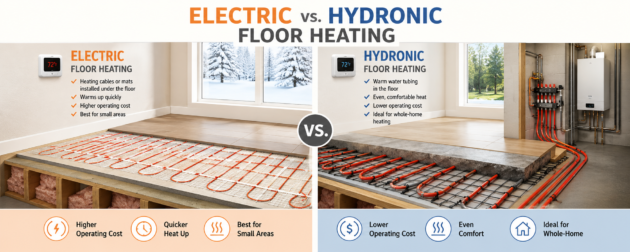
Electric vs hydronic
Install & operating cost
Which one, and when
Part of: Radiant & In-Floor Heating in Ontario · How radiant works
Electric vs Hydronic Floor Heating in Ontario: Which One, and When
Both warm your floor and both feel wonderful – but they cost very different amounts to run, and that’s the whole decision. Here’s the builder’s one-line rule: electric for a room, hydronic for a home. This guide lays out what each costs to install and to operate at Ontario electricity rates, where the break-even sits, and why most homes end up using both – electric in the bathroom, hydronic everywhere that matters.
$8-$15/sf
Electric (install)
$7-$15/sf
Hydronic (install)
~200 sf
Break-even point
40-60%
Hydronic runs cheaper at scale
The 30-second rule
If you remember one thing, make it this: electric radiant is cheap to install and expensive to run; hydronic is the reverse. So electric wins for a small, targeted space – a bathroom, an ensuite, a kitchen, an entry – where you want warm tile underfoot without a mechanical room. Hydronic wins for whole areas and primary heat – a basement, a main floor, a whole house – where the lower operating cost pays back the bigger install over the life of the home. The crossover sits at roughly 200 square feet: below that, electric usually makes more sense; above it, hydronic pulls ahead and keeps pulling. The deeper hydronic cost picture is on the Ontario radiant cost page.
How each one actually works
Electric (resistance mats & cable)
A thin electric heating cable or pre-spaced mat goes right under the tile and warms the floor directly with electricity – the same idea as the element in a toaster, spread out and gentle. No boiler, no pumps, no manifolds, almost no added floor height. It heats up fast and installs in an afternoon, which is exactly why it owns the bathroom-reno market.
Hydronic (warm water)
Warm water circulates through PEX tubing in the slab or a topping, fed by a heat source – a combi, boiler, or heat pump. There’s more equipment (the mechanical room is the cost), but it heats large areas far more cheaply and runs on efficient, low-temperature sources. It’s the whole-home solution. The heat-source side is on hydronic heating.
Install cost: electric looks cheaper (for a reason)
Per square foot, the two land close – but the project totals diverge because of what’s behind the floor.
| Electric | Hydronic | |
|---|---|---|
| Installed cost | $8 – $15 / sq ft | $7 – $15 / sq ft |
| A typical bathroom | $600 – $1,200 | Rarely done on its own |
| Whole home (1,500-2,000 sq ft) | Impractical as primary heat | $12,000 – $30,000 |
| Mechanical room | None needed | Boiler / combi / heat pump, pumps, manifolds |
| Cost per sq ft as area grows | Stays flat | Drops – rooms share one heat source |
Electric is cheaper for one room because there’s no mechanical room to build. Hydronic’s per-square-foot cost falls as you add area, because every room shares the same boiler and pumps – which is why it’s the value play for a whole house and a money-loser for a single bathroom.
Operating cost: where hydronic runs away with it
This is the part that decides large projects. Electric radiant is pure resistance heat – every unit of warmth costs you a full unit of electricity, and at Ontario’s mid-teens-cents-per-kWh rates that adds up fast across a big floor. Hydronic, run on a condensing boiler or – especially – a low-temperature heat pump, delivers the same comfort for far less purchased energy, and the gap widens the more area you heat. Industry data consistently shows hydronic costing roughly 40 to 60% less to operate than electric over large areas.
Real Ontario numbers: a heated bathroom floor on electric costs only about a dollar a day to run for a few hours of use – perfectly affordable, which is why electric is great for small spaces. But scale that resistance heat up to a whole house and you’ve picked the most expensive fuel for the biggest job. As a daily ballpark, electric heated floors run roughly $1 to $5 a day, hydronic about $0.50 to $3 – and that spread compounds every single day of an Ontario winter.
Where each one wins
Choose electric when
- You’re heating one small space – bathroom, ensuite, kitchen, entry
- It’s a retrofit or reno and you’re already replacing the tile
- You want minimal added floor height and no mechanical room
- You want fast warm-up for comfort, not primary heat
Choose hydronic when
- You’re heating a whole area or the whole home
- It’s a new build (slab, basement, full floors)
- You want the lowest operating cost over the life of the house
- You want to pair with a heat pump, boiler, combi, or solar
Can electric heat a whole house in Ontario?
Technically yes; practically no. You can cover a whole home in electric mats, but at Ontario electricity rates the running cost makes it impractical as a primary whole-house system – the bills are simply too high through a long winter. For whole-home radiant in this province, hydronic is the viable choice, ideally on an efficient low-temperature heat source. Whether radiant can carry your house at all is its own question, answered on will radiant heat my house, and the broader furnace comparison is on radiant vs forced air.
The smart move: use both
Most well-built Ontario homes don’t choose one or the other – they use each where it shines. Hydronic carries the house (the slab, the basement, the main floors), and electric mats add a touch of luxury in the spots hydronic doesn’t reach economically: a warm ensuite floor on a separate thermostat, a heated entry, a cottage bathroom. You get whole-home efficiency and pinpoint comfort, and each system does the job it’s actually good at.
Going hydronic? The savings start with the right size.
Size the hydronic system so it actually saves you money
Hydronic’s lower operating cost only shows up when the system is sized right and runs at low water temperatures – and that comes out of a CSA F280-12 heat-loss calculation, the BCIN-stamped paperwork your Ontario permit requires. Upload your plan and our engineer emails you a price. More: do I need a heat-loss calculation?
Get a radiant in-floor heating quote
We’ve designed and installed both electric and hydronic radiant in our own ICF homes for 30+ years, and we’ll tell you honestly which fits your space. Tell us about your project and we’ll call you back, usually within one business day, with a real plan and price. No cost, no obligation.
OK
You’re on the list!
Thanks – we’ll call you within one business day to talk through electric vs hydronic for your project.
Not sure which system fits? Get a one-on-one consult.
Electric vs hydronic for your rooms, operating-cost math, or a second opinion on a quote. We scope it on a quick call and send a secure payment link – you only pay once you know what you’re getting.
Building new? The HST rebate can cover a big slice
If radiant is going into a new build, that home likely qualifies for Ontario’s enhanced HST rebate – up to $130,000 back if your build contract is signed before the deadline. Check your number before you commit.
Ontario HST Rebate | Deadline April 1, 2027
You Could Lose Up To $106,000 If You Don’t Start Before April 2027
Ontario’s enhanced HST rebate puts up to $130,000 back in a new-home builder’s pocket – but only if your build contract is signed before April 1, 2027. Miss that window and you fall back to the standard $24,000 rebate.
$0
Contract signed before Apr 1, 2027
$24,000
Signed after the deadline
$900,000
Miss the deadline and you forfeit
$0
Estimate based on Ontario’s 2026 enhanced HST rebate (Bill 114). Final eligibility is confirmed by a licensed rebate specialist – that’s what the free check is for. Full HST rebate details
Hydronic pairs best with ICF
An ICF home loses less heat, so the hydronic system runs at lower water temperatures and a smaller, cheaper heat source - which widens hydronic's operating-cost advantage even further. It's the combination we build into our own homes. See what ICF is, browse our ICF house plans (every one offered with the ICF + radiant package), run the ICF cost calculator, or check code with the OBC Code Navigator.
All radiant guides
Radiant & in-floor hub
Radiant heating design
Simcoe County
Basement radiant
Radiant cost in Ontario
Radiant vs forced air
Radiant floor heating 101
In-floor systems & methods
Hydronic heating
Solar radiant heating
Solar thermal vs PV
Radiant + flooring
Will radiant heat my house?
Do I need a heat-loss calc?
Heated garage & shop floors
Radiant floor cooling
Heat-loss calculator
Electric vs hydronic floor heating: frequently asked questions
Electric or hydronic radiant floor heating - which is better?
Neither is universally better; they win in different situations. Electric is cheaper to install and best for small, targeted spaces like bathrooms and kitchens, where it heats up fast and needs no mechanical room. Hydronic costs more up front but is much cheaper to run over large areas and is the right choice for whole-home heating. The simple rule: electric for a room, hydronic for a home.
Is electric or hydronic cheaper to install?
Per square foot they're close - roughly $8 to $15 for electric and $7 to $15 for hydronic installed. But for a single small room electric is far cheaper per project because there's no boiler, pumps, or manifolds. For a whole home, hydronic's cost per square foot drops as rooms share one heat source, while electric's stays flat.
Is electric or hydronic cheaper to run?
Hydronic, clearly, over any meaningful area - commonly 40 to 60% cheaper to operate than electric. Electric resistance heat costs a full unit of electricity for every unit of warmth, while hydronic on a condensing boiler or heat pump delivers the same comfort for less purchased energy, and the gap grows the more floor you heat.
How much does electric radiant cost to run in Ontario?
For a small space it's cheap - a heated bathroom floor runs only about a dollar a day for a few hours of use. As a daily ballpark, electric heated floors run roughly $1 to $5 per day and hydronic about $0.50 to $3, at Ontario's mid-teens-cents-per-kWh electricity rates. The more area you heat on electric, the faster those numbers climb.
Can electric radiant heat a whole house in Ontario?
It can technically, but it's not practical as a primary whole-house system at Ontario electricity rates - the winter bills are simply too high. For whole-home radiant here, hydronic on an efficient low-temperature heat source is the viable choice. Electric is best kept to small comfort zones.
What's the break-even between electric and hydronic?
Around 200 square feet is the common rule of thumb. Below that, electric usually makes more sense on total cost. Above it, hydronic's lower operating cost starts to outweigh its higher install cost, and the advantage keeps growing with area - which is why whole-home projects are almost always hydronic.
Which heats up faster, electric or hydronic?
Electric, because it warms the floor surface directly and there's little mass to bring up to temperature. That fast response is part of why electric suits bathrooms, where you want warm tile on a schedule. Hydronic in a slab is slow and steady by design - it's a set-and-forget primary heat, not an on-demand booster.
Can I use both electric and hydronic in one house?
Yes, and it's often the smartest plan. Hydronic carries the house - the slab, basement, and main floors - while electric mats add warm-floor luxury in the spots hydronic doesn't reach economically, like an ensuite or entry on its own thermostat. Each system does the job it's actually good at.
Does electric radiant need a mechanical room?
No - that's one of its biggest advantages. Electric mats or cable connect to a thermostat and your electrical panel, with no boiler, pumps, manifolds, or mechanical room. That's why it's so easy to add during a bathroom or kitchen renovation. Hydronic, by contrast, needs a heat source and mechanical room.
Which adds less floor height?
Electric. The mats and cable are very thin and go right under the tile, adding almost nothing to the floor build-up - ideal for retrofits where door and transition heights are tight. Hydronic needs the tubing embedded in a slab or a topping, which is why it's easiest in new construction.
Note: figures are 2026 Ontario planning ranges for general guidance, not a quote. Operating cost depends on your electricity rate, fuel, heat source, insulation, and how you use the system.
More on heating and efficiency
Reviewed and updated October 2026. Costs on this site are Ontario ranges, not quotes; code references are to the Ontario Building Code in force at the date above.
Latest posts
Fresh guides, calculators & real-world advice
More from BuildersOntario - scroll to explore.
Loading latest posts...
Tip: shift + mousewheel works great
Sizing a radiant floor? The design starts with the heat loss.
Tubing spacing, water temperature and boiler size all come from a room-by-room CSA F280 calculation. Ontario Heat Loss delivers certified calculations and complete hydronic designs in 48 hours.
Certified CSA F280 heat loss report — $395, 48h · Full HVAC design & mechanical drawings — $695