Ontario's Plain-English Guide to Custom Home Building📞 705-533-1633 | ☎️ 1-866-868-6606 | ✉️ info@icfhome.ca

Radiant Heat vs Forced Air in Ontario: The Honest Comparison
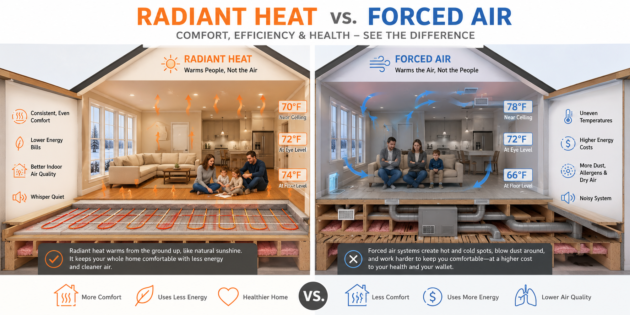
Radiant vs forced air
Comfort, efficiency, cost, air quality
The honest head-to-head
Part of: Radiant & In-Floor Heating in Ontario · How radiant works
Radiant Heat vs Forced Air in Ontario: The Honest Comparison
We’ve installed radiant for 30+ years and we love it – so here’s the fair version, not the sales pitch. Radiant wins the daily living experience: even, quiet, draft-free, dust-free comfort that’s cheaper to run. Forced air wins the sticker price and does one thing radiant can’t – it moves air, so it handles heating, cooling, and ventilation through a single duct system. This guide lays out comfort, efficiency, cost, and air quality side by side, and where each one genuinely belongs.
25-30%
Radiant efficiency edge
~1 F vs ~5 F
Room-to-room temp swing
Up to 30%
Forced-air duct losses
$5k-$12k
Forced air install
How they heat – and why it feels so different
Forced air heats the air and blows it around: the furnace fires, a blast of hot air comes through the registers, the warm air rises to the ceiling, the room slowly cools, and the furnace fires again. You get temperature swings, drafts, blower noise, and dust on the move. Radiant heats the surfaces and the people directly from the floor up, with no moving air – so the warmth is even from floor to ceiling, silent, and steady. That single difference is behind almost every comparison below. The full “how radiant works” is on radiant floor heating 101.
Comfort: radiant, clearly
This is radiant’s home turf. Because it warms the whole floor instead of blowing hot air, the temperature is remarkably even – room-to-room variation of about 1 F with radiant versus around 5 F with forced air. There are no cold drafts near windows and doors, no hot-then-cold cycling, and no blower roaring to life at 2 a.m. You feel a gentle, enveloping warmth that lets you stay comfortable at a slightly lower thermostat setting. Most people who live with it describe it the same way: you stop noticing the heating system entirely, which is the highest compliment a heating system can get.
Efficiency: radiant’s quiet advantage
Radiant is typically 25 to 30% more energy-efficient than forced air, for two structural reasons. First, no duct losses – leaky, uninsulated ductwork can waste up to 30% of a forced-air system’s energy before it ever reaches the room, and radiant has no ducts to leak. Second, radiant runs at lower temperatures (roughly 85 to 125 F supply versus 120 to 145 F for forced air), which keeps a condensing boiler or heat pump in its efficient range. Add the lower thermostat setting radiant allows, and a well-built radiant home is meaningfully cheaper to heat. The dollars-and-cents are on the Ontario radiant cost page and the heat-source efficiency on hydronic heating.
Air quality and noise: radiant again
Because radiant doesn’t move air, it doesn’t circulate dust, pollen, pet dander, or other allergens around your home, and there’s no hot surface scorching dust particles – which makes it the better choice for anyone with allergies or asthma. It’s also silent: no whoosh from the vents, no furnace rumble, no constant cycling. Forced air can mitigate the dust with high-efficiency filters, but it’s managing a problem radiant simply doesn’t create. And maintenance follows the same pattern – radiant has almost no moving parts, so it asks for little beyond the occasional check, while a furnace and blower need regular service.
Cost: forced air’s strong card
Here’s where forced air earns its place. It’s much cheaper to install – roughly $5,000 to $12,000 for a typical home, versus about $10 to $20 per square foot ($15,000 to $35,000) for radiant. And in an existing home that already has ductwork, adding or replacing forced air is far simpler than tearing into floors for radiant. Radiant’s higher upfront cost is bought back over time through lower operating cost and comfort – but if the lowest possible sticker price is the priority, forced air wins that specific fight. The honest “where radiant isn’t the best fit” sits right here.
| Radiant floor heat | Forced air | |
|---|---|---|
| Comfort & evenness | Even, draft-free (~1 F) | Swings and drafts (~5 F) |
| Efficiency | 25-30% better, no duct loss | Up to 30% lost in ducts |
| Air quality / allergies | No dust circulated | Circulates dust (filterable) |
| Noise | Silent | Blower & vent noise |
| Install cost | $15,000 – $35,000 | $5,000 – $12,000 |
| Cooling & ventilation | Heat only – needs separate AC + HRV | Heating, cooling & air in one system |
| Retrofit into existing home | Disruptive (floors) | Easy if ducts exist |
The honest case for forced air (and the Ontario catch)
Forced air’s real superpower isn’t heating – it’s that the same ductwork does heating, cooling, and ventilation. One system, one set of ducts, summer and winter. Radiant only heats, which leads to the most important planning point in this whole comparison:
Radiant is heat-only, so an Ontario home still needs an air plan. Pick radiant and you’ll add two things forced air bundles in: ventilation (an HRV or ERV is required in a new Ontario home and is good practice in any tight house) and cooling (a heat pump, ducted system, or mini-splits for summer AC). The good news is this is often a feature, not a burden – an air-to-water heat pump can run your radiant in winter and provide cooling in summer, and a right-sized HRV/ERV gives you better fresh-air control than a furnace ever did. It’s just not “free” the way it is with forced air, so budget for it from day one.
So the real choice isn’t always either/or. Many Ontario homes pair radiant heat with a heat pump and an HRV – radiant comfort in winter, efficient cooling and fresh air the rest of the year. If you’re wondering whether radiant can carry the whole house at all, that’s on will radiant heat my house, and the electric-vs-hydronic side of radiant is on electric vs hydronic.
So which should you choose?
Lean radiant when
- You’re building new and can design it in
- Comfort, quiet, and clean air matter to you
- You want the lowest operating cost long-term
- Someone in the home has allergies or asthma
Lean forced air when
- The lowest upfront cost is the priority
- It’s an existing home that already has ducts
- You want heating and central cooling in one system
- You want fast temperature changes over steady warmth
Comparing systems? Start with the load, not the brochure.
The heat-loss number sizes radiant, the heat pump, and the HRV
Whether you go radiant, forced air, or radiant plus a heat pump, it all starts with a CSA F280-12 heat-loss calculation – it sizes the equipment, sets radiant water temperatures, and is the BCIN-stamped paperwork your Ontario permit requires. Upload your plan and our engineer emails you a price. More: do I need a heat-loss calculation?
Get a radiant in-floor heating quote
We’ve designed radiant – and the heat pump and HRV that go with it – in our own ICF homes for 30+ years, and we’ll give you the honest comparison for your project. Tell us about it and we’ll call you back, usually within one business day, with a real plan and price. No cost, no obligation.
OK
You’re on the list!
Thanks – we’ll call you within one business day to compare radiant and forced air for your project.
Comparing radiant to a furnace? Get a one-on-one consult.
The real cost and comfort math for your home, the cooling and ventilation plan, or a second opinion on a quote. We scope it on a quick call and send a secure payment link – you only pay once you know what you’re getting.
Building new? The HST rebate can cover a big slice
If radiant is going into a new build, that home likely qualifies for Ontario’s enhanced HST rebate – up to $130,000 back if your build contract is signed before the deadline. Check your number before you commit.
Ontario HST Rebate | Deadline April 1, 2027
You Could Lose Up To $106,000 If You Don’t Start Before April 2027
Ontario’s enhanced HST rebate puts up to $130,000 back in a new-home builder’s pocket – but only if your build contract is signed before April 1, 2027. Miss that window and you fall back to the standard $24,000 rebate.
$0
Contract signed before Apr 1, 2027
$24,000
Signed after the deadline
$900,000
Miss the deadline and you forfeit
$0
Estimate based on Ontario’s 2026 enhanced HST rebate (Bill 114). Final eligibility is confirmed by a licensed rebate specialist – that’s what the free check is for. Full HST rebate details
Radiant pairs best with ICF
The radiant-vs-forced-air gap widens in a tight, well-insulated home. An ICF house has such low heat loss that radiant runs at very low water temperatures - quiet, even, cheap to heat - and pairs naturally with a heat pump that also handles summer cooling. It's the combination we build into our own homes. See what ICF is, browse our ICF house plans (every one offered with the ICF + radiant package), run the ICF cost calculator, or check code with the OBC Code Navigator.
All radiant guides
Radiant & in-floor hub
Radiant heating design
Simcoe County
Basement radiant
Radiant cost in Ontario
Electric vs hydronic
Radiant floor heating 101
In-floor systems & methods
Hydronic heating
Solar radiant heating
Solar thermal vs PV
Radiant + flooring
Will radiant heat my house?
Do I need a heat-loss calc?
Heated garage & shop floors
Radiant floor cooling
Heat-loss calculator
Radiant heat vs forced air: frequently asked questions
Is radiant heat better than forced air?
For comfort, efficiency, quiet, and air quality, yes - radiant is even (about 1 F room to room versus 5 F), draft-free, silent, doesn't circulate dust, and runs 25 to 30% more efficiently. Forced air's advantages are a much lower install cost and the fact that one duct system also delivers cooling and ventilation. So radiant is "better" for daily living; forced air is "better" for upfront cost and all-in-one air handling.
Is radiant or forced air cheaper?
Forced air is cheaper to install - roughly $5,000 to $12,000 for a typical home versus about $10 to $20 per sq ft ($15,000 to $35,000) for radiant - and it's far simpler to add in a home that already has ducts. Radiant costs more up front but is cheaper to operate, so it tends to win on lifetime cost in a home you'll keep, especially a well-insulated one.
Is radiant heat more efficient than forced air?
Yes - typically 25 to 30% more efficient. Two reasons: radiant has no ducts, and leaky ductwork can waste up to 30% of a forced-air system's energy; and radiant runs at lower water temperatures, which keeps a condensing boiler or heat pump efficient. The even warmth also lets you stay comfortable at a slightly lower thermostat setting.
Is radiant better for allergies and dust?
Yes. Because radiant doesn't move air, it doesn't circulate dust, pollen, or pet dander, and there's no hot surface scorching dust particles - so allergens stay settled. Forced air can help with high-efficiency filters, but it's managing a problem radiant doesn't create, which makes radiant the better pick for allergy and asthma sufferers.
Does radiant heat do air conditioning too?
No - radiant floor heating only heats. For summer cooling you add a separate system, commonly an air-to-water heat pump (which can also run your radiant in winter), a ducted AC, or mini-splits. Forced air, by contrast, delivers heating and cooling through the same ductwork, which is one of its real advantages.
Do I still need ductwork with radiant heat?
Not for the heating itself, but an Ontario new home still needs mechanical ventilation - an HRV or ERV - and you'll want a cooling system for summer. Those can be ducted or use mini-splits. So a radiant home isn't duct-free by default; it just doesn't use ducts to heat. Budget for the ventilation and cooling from day one.
Is radiant quieter than forced air?
Much quieter - effectively silent. There's no blower, no whoosh through vents, and no furnace cycling on and off. Forced air is hard to ignore by comparison: the rush of air and the rumble of the furnace are constant background noise. For a calm, quiet house, radiant wins easily.
Which is more comfortable, radiant or forced air?
Radiant, by most people's experience. The warmth is even from floor to ceiling with almost no temperature swing, there are no cold drafts by the windows, and your feet are warm. Forced air heats in blasts that rise to the ceiling and leave cool spots, and the moving air can feel drafty. Once people live with radiant, they rarely want to go back.
Can I have both radiant and forced air?
Yes, and a common modern Ontario setup is radiant heat paired with a heat pump for cooling and an HRV/ERV for fresh air - radiant comfort in winter, efficient cooling and ventilation the rest of the year. You get the best of both: even, quiet heat plus proper summer cooling and air exchange.
Is forced air ever the better choice?
Yes - when the lowest upfront cost is the priority, when you're working in an existing home that already has ductwork, or when you want heating and central cooling delivered by one system with minimal fuss. Forced air is a perfectly good system; radiant simply delivers more comfort and lower operating cost for a higher initial investment.
Note: figures are 2026 planning ranges for general guidance, not a quote. Real comfort and operating cost depend on your envelope, fuel, heat source, ductwork, and how the system is designed and run.
More on heating and efficiency
Reviewed and updated October 2026. Costs on this site are Ontario ranges, not quotes; code references are to the Ontario Building Code in force at the date above.
Latest posts
Fresh guides, calculators & real-world advice
More from BuildersOntario - scroll to explore.
Loading latest posts...
Tip: shift + mousewheel works great
Decided? Either system needs a certified design.
Radiant or forced-air, Ontario permits need a CSA F280 heat loss and a distribution design. Ontario Heat Loss produces both, BCIN-stamped, in 48 hours.
Certified CSA F280 heat loss report — $395, 48h · Full HVAC design & mechanical drawings — $695