Ontario's Plain-English Guide to Custom Home Building📞 705-533-1633 | ☎️ 1-866-868-6606 | ✉️ info@icfhome.ca

Will Radiant Heat My House? The Honest Answer for an Ontario Winter
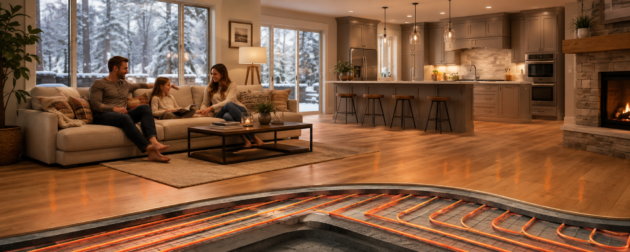
Can radiant be your only heat?
Sizing | floor output | big windows
When backup is needed
Part of: Radiant & In-Floor Heating in Ontario · How radiant works
Will Radiant Heat My House? The Honest Answer for an Ontario Winter
Short version: yes – radiant can be the only heat source in your home, even through an Ontario winter – as long as it’s sized to your home’s actual heat loss and the envelope isn’t a sieve. We’ve lived in radiant-only homes since 1991 and they’re toasty on the coldest Georgian Bay nights. The catch is a real one: a floor can only put out so much heat before it’s too warm underfoot, so the answer comes down to your heat loss, your insulation, and a couple of room shapes that need a closer look.
Yes
As sole heat, sized right
~30-40
BTU/sf a floor can deliver
80-85 F
Floor surface ceiling
Envelope
The real deciding factor
The one rule that decides it: floor output vs heat loss
Every room loses a certain amount of heat on a design-cold day – that’s its heat loss, measured in BTU per hour. A radiant floor can supply a certain amount back, but there’s a hard ceiling: the floor can’t get too hot or it’s uncomfortable underfoot and bad for your finishes. Floors should stay around 80 F and never exceed about 85 F on a routine basis, and at those comfortable temperatures a floor delivers roughly 30 to 40 BTU per hour per square foot. Push for much more and you’d need floor temperatures above 90 F – too hot to live on. So the whole question is simple: can the floor area in each room supply more BTU than that room loses? In most well-built homes, easily yes. In a glass-walled room with little floor, sometimes no – and that’s where supplemental heat comes in.
How much heat your floor needs to make
Your required output per square foot depends on how leaky the house is and how cold it gets. These are planning ranges – your real numbers come from a heat-loss calculation.
| Home / room | Roughly needs | Within a floor’s reach? |
|---|---|---|
| Well-insulated, tile floor (typical new build) | 30 – 35 BTU/hr/sq ft | Yes, comfortably |
| Tight, low-load home (e.g. ICF) | Often well under 30 | Yes, with room to spare |
| Poorly insulated or very cold climate | 45 – 55 BTU/hr/sq ft | At or past the limit – supplemental likely |
| Carpeted floor | Limited to ~15 – 20 BTU/hr/sq ft output | Low output – keep carpet thin |
See the pattern: a tight, well-insulated home sits comfortably inside what a floor can deliver, while a leaky house or a heavy carpet pushes against the ceiling. That’s why the building envelope matters more than the heating system – more on that below. (Carpet’s output limit is why the flooring you choose matters.)
Where radiant struggles: lots of glass, little floor
The classic problem room is the one with a wall of windows and not much floor – a sunroom, a glassy great room, a two-storey window feature. Big glass loses a lot of heat, and if there isn’t enough floor area to supply it back within the temperature limit, the floor alone can’t keep that room comfortable on the coldest days. The honest planning view from the research: if a room’s heating need is just slightly above what the floor can supply, radiant can carry it for three seasons and lean on a little supplemental heat in the deep cold; if the gap is large, that room needs a dedicated boost – a radiant wall or panel, a toe-kick heater, or a small supplemental source. This is exactly why every room gets calculated individually rather than the house being treated as one big number.
Good news: high ceilings actually favour radiant
People worry that vaulted ceilings and big volumes will defeat radiant – it’s the opposite. Forced air dumps warm air that rises and pools uselessly at a high ceiling, so you burn extra energy trying to push heat down to where people are. Radiant warms the floor and the people directly and lets the warm air stay low where it belongs, so a great room with a soaring ceiling is one of the places radiant shines brightest. Tall ceilings are a reason to choose radiant, not to avoid it.
The real answer: it’s the envelope, not the heater
Here’s the truth thirty years of building has hammered home: once your home is tight and well-insulated, how you heat it barely matters – and radiant becomes the easy, obvious sole source. Reduce air leakage, add insulation, and use good windows, and the heat loss drops below what a floor can comfortably supply with margin to spare. That’s why our own ICF homes run on radiant alone and stay 24 C with no fuss.
This is the ICF advantage in one sentence: an ICF house loses so little heat that the floor never has to work hard – low water temperatures, small equipment, and radiant easily as the only heat through the worst of winter. The leakier the house, the more radiant has to fight; the tighter the house, the more radiant just disappears into the background and does the whole job. If you’re deciding whether radiant will heat your house, the most powerful move is to build the house that makes the answer an easy yes.
For the build-it-tight side, see what ICF is, and for the comfort and controls behind day-to-day radiant living, radiant floor heating 101 and hydronic heating.
Do you need backup heat?
Usually no, in a correctly sized home – the radiant carries it. You add a touch of supplemental only in the specific cases above: a high-glass room that outruns its floor, or a leaky building you can’t fully fix. There’s also the cottage case: a seasonal place you let go cold needs a Wi-Fi thermostat to bring the slab up about six hours before you arrive, and many cottages keep a wood stove for instant warmth on arrival while the floor catches up. None of that means radiant “can’t” heat the house – it means a couple of rooms or use-patterns get a sensible assist. The way to know for sure, before you spend a dollar, is the heat-loss calculation.
“Will it heat my house?” is answered by one calculation.
Get the heat-loss that proves radiant will carry your home
A room-by-room CSA F280-12 heat-loss calculation compares each room’s loss to what its floor can supply – so you know, before you build, exactly where radiant carries the load and where (if anywhere) you need a boost. It’s also the BCIN-stamped paperwork your Ontario permit requires. Upload your plan and our engineer emails you a price. More: do I need a heat-loss calculation?
How to know for sure
Radiant will carry it when
- The home is reasonably tight and well-insulated
- Heat loss is at or below ~30-40 BTU/hr per sq ft of floor
- Rooms have enough floor area for their windows
- You’re building new and can design it in
Plan for a little help when
- A room is mostly glass with little floor (sunroom, feature wall)
- The building is leaky and can’t be fully upgraded
- Floors will be carpeted (low output)
- It’s a seasonal cottage left cold between visits
Get a radiant in-floor heating quote
We’ve designed radiant as the sole heat source in our own ICF homes for 30+ years, and we’ll tell you honestly whether it’ll carry your house. Tell us about your project and we’ll call you back, usually within one business day, with a real plan and price. No cost, no obligation.
OK
You’re on the list!
Thanks – we’ll call you within one business day to talk through whether radiant will carry your home.
Worried radiant won’t keep up? Get a one-on-one consult.
We’ll talk through your floor area, windows, and envelope and tell you straight whether radiant will carry the house, or scope where a small assist makes sense. Quick call, then a secure payment link – you only pay once you know what you’re getting.
Building new? The HST rebate can cover a big slice
If radiant is going into a new build, that home likely qualifies for Ontario’s enhanced HST rebate – up to $130,000 back if your build contract is signed before the deadline. Check your number before you commit.
Ontario HST Rebate | Deadline April 1, 2027
You Could Lose Up To $106,000 If You Don’t Start Before April 2027
Ontario’s enhanced HST rebate puts up to $130,000 back in a new-home builder’s pocket – but only if your build contract is signed before April 1, 2027. Miss that window and you fall back to the standard $24,000 rebate.
$0
Contract signed before Apr 1, 2027
$24,000
Signed after the deadline
$900,000
Miss the deadline and you forfeit
$0
Estimate based on Ontario’s 2026 enhanced HST rebate (Bill 114). Final eligibility is confirmed by a licensed rebate specialist – that’s what the free check is for. Full HST rebate details
The surest way to make the answer "yes": ICF
If you want radiant to heat your house without a second thought, build the house that makes it effortless. An ICF home's heat loss is so low that the floor barely has to work - radiant runs cool, the equipment is small, and the floor's output limit is never even close to a problem. It's the combination we build into our own homes. See what ICF is, browse our ICF house plans (every one offered with the ICF + radiant package), run the ICF cost calculator, or check code with the OBC Code Navigator.
All radiant guides
Radiant & in-floor hub
Radiant heating design
Simcoe County
Basement radiant
Radiant cost in Ontario
Electric vs hydronic
Radiant vs forced air
Radiant floor heating 101
In-floor systems & methods
Hydronic heating
Solar radiant heating
Solar thermal vs PV
Radiant + flooring
Do I need a heat-loss calc?
Heated garage & shop floors
Radiant floor cooling
Heat-loss calculator
Will radiant heat my house: frequently asked questions
Can radiant floor heating be my only heat source?
Yes - in a correctly sized, reasonably insulated home, hydronic radiant is regularly the primary and only heat, even through an Ontario winter. The key is matching the system to your home's calculated heat loss, room by room, and keeping the envelope tight enough that each room's loss stays within what its floor can supply. We've lived in radiant-only homes since 1991.
Will radiant heat a whole house in a cold Ontario winter?
It can, and routinely does. Radiant can be a sole heat source even in harsh climates as long as it's sized to your heat loss down to the BTU. In a tight, well-insulated home the floor easily supplies more heat than the house loses; in a leaky one or a glass-heavy room, you may need a small supplemental source on the coldest days.
How many BTU per square foot does a radiant floor deliver?
At comfortable floor temperatures (around 80 to 85 F), a radiant floor delivers roughly 30 to 40 BTU per hour per square foot. A well-insulated home with tile floors typically needs about 30 to 35, so it fits comfortably; a poorly insulated home or very cold climate can need 45 to 55, which is at or past the limit and points to supplemental heat. Carpet drops a floor's output to about 15 to 20.
What's the maximum a radiant floor can put out?
It's capped by comfort, not by the system. Floors should stay around 80 F and not exceed about 85 F routinely, and pushing past roughly 45 BTU per hour per square foot would require floor temperatures above 90 F - too hot to walk on and hard on finishes. So the practical ceiling is in the 30 to 40 BTU range, which is why heat loss has to be kept under that.
Does radiant work with big windows and lots of glass?
It can, but glass-heavy rooms with little floor are the one place radiant can fall short, because big windows lose a lot of heat and there may not be enough floor to supply it back within the temperature limit. Those rooms - sunrooms, two-storey window walls - often get a dedicated assist like a radiant panel or a small supplemental heater for the coldest days. A room-by-room heat-loss calculation catches this in advance.
Is radiant good for high ceilings and vaulted rooms?
Excellent, actually - better than forced air. Forced air sends warm air up to pool uselessly at a high ceiling, while radiant warms the floor and people directly and lets the warm air stay low where you are. A great room with a soaring ceiling is one of radiant's best showcases, not a problem for it.
Do I need supplemental or backup heat with radiant?
Usually not in a correctly sized, well-built home - the radiant carries it. You add a little supplemental only for specific cases: a high-glass room that outruns its floor, a leaky building you can't fully fix, or a seasonal cottage left cold between visits (where a wood stove gives instant warmth while the slab catches up). The heat-loss calculation tells you exactly where, if anywhere, you need it.
What makes radiant fall short?
Almost always a mismatch between heat loss and floor output: too much glass for the floor area, a leaky or under-insulated envelope, heavy carpet limiting output, or - most commonly - a system that was never sized with a proper heat-loss calculation. Fix the envelope and size it correctly and radiant carries the house; skip those and it struggles.
How do I know if radiant will heat my house?
Get a room-by-room CSA F280-12 heat-loss calculation. It compares each room's heat loss to what its floor can supply, so you know before you build exactly where radiant carries the load and where you might want a boost. It's also the BCIN-stamped paperwork your Ontario permit requires, so it does double duty.
Does insulation matter more than the heating system?
Yes. Once a home is tight and well-insulated, the heat loss drops below what a radiant floor can comfortably supply, and radiant becomes an easy sole source. The single most powerful thing you can do to guarantee radiant will heat your house is to build a better envelope - reduced air leakage, more insulation, good windows. After that, how you heat it almost takes care of itself.
Note: BTU and temperature figures are general planning guidance, not a quote. Whether radiant carries your specific home is confirmed by a room-by-room heat-loss calculation for your design, climate, and finishes.
Latest posts
Fresh guides, calculators & real-world advice
More from BuildersOntario - scroll to explore.
Loading latest posts...
Tip: shift + mousewheel works great
Sizing a radiant floor? The design starts with the heat loss.
Tubing spacing, water temperature and boiler size all come from a room-by-room CSA F280 calculation. Ontario Heat Loss delivers certified calculations and complete hydronic designs in 48 hours.
Certified CSA F280 heat loss report — $395, 48h · Full HVAC design & mechanical drawings — $695