Ontario's Plain-English Guide to Custom Home Building📞 705-533-1633 | ☎️ 1-866-868-6606 | ✉️ info@icfhome.ca

Heated Garage & Shop Floor Cost in Ontario: What It Takes and What It Runs
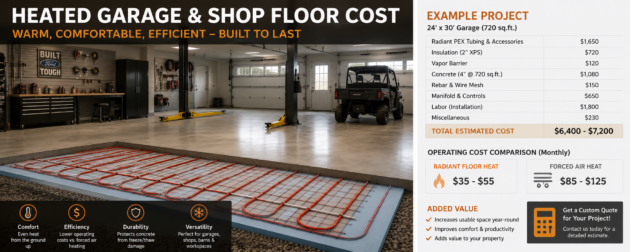
Heated garage & shop floors
Cost, insulation, glycol, sizing
One of Ontario’s best upgrades
Part of: Radiant & In-Floor Heating in Ontario · In-floor systems
Heated Garage & Shop Floor Cost in Ontario: What It Takes and What It Runs
A heated slab is one of the most satisfying upgrades you can put in an Ontario garage or shop – it dries the slush off your truck, kills the damp chill, and makes the space genuinely usable all winter without blowing dust around. Here’s what it costs to build and to run, the two details that make or break it (insulation and glycol), and how to size it so you’re heating the room, not the dirt.
$6-$17/sf
Hydronic slab (installed)
$5k-$10k
Typical garage / shop
~30 c/sf
Per month to run
Glycol
Required in a slab loop
Why a heated slab is the right call for a shop
For a garage or workshop, in-floor radiant beats a hanging unit heater on almost every count. It warms the whole floor and everything on it – so a snow-covered truck dries instead of leaving a slushy puddle, the concrete is never that bone-deep cold, and the heat is even from corner to corner instead of roasting your head while your feet freeze. There’s no blower throwing dust and fumes around a space where you’re sanding, painting, or welding, and it’s silent. It’s also a big warm thermal mass, so once the slab is up to temperature it holds it well. The methods for getting tubing into a slab are on in-floor systems & methods.
What it costs to build
Real Ontario planning ranges for an in-slab hydronic system – the tubing, manifolds, and controls, installed:
| Scope | Typical 2026 range | Notes |
|---|---|---|
| In-slab hydronic (installed) | $6 – $17 / sq ft | Tubing, manifolds, controls – plus the heat source |
| Typical garage / shop project | $5,000 – $10,000 | Tubing embedded during the pour; varies with size and heat source |
| New build vs retrofit | 30 – 50% less new | In-slab is cheap during the pour, costly to add later |
| Operating cost | ~30 cents / sq ft / month | Economical for long-running heated space, with insulation |
The two biggest cost drivers are the heat source you tie into and how well the slab is insulated – and that second one decides your bills for the life of the building. The whole-home hydronic cost picture is on the Ontario radiant cost page.
Make-or-break #1: insulate under and around the slab
This is the difference between a warm shop and a warm planet. Bare concrete on dirt wicks your heat straight into the ground and out the edges – so a heated slab must be insulated, or you’ll spend the building’s whole life paying to warm the soil. Two pieces matter:
Under-slab insulation: 1 to 2 inches of rigid XPS foam under the entire heated slab (roughly R-10) is essential for radiant – it’s what makes the floor warm and dry instead of a heat sink to the earth. At R-10, a heated shop slab loses a fraction of what a bare one does.
Slab-edge insulation: the perimeter is where heat sprints out fastest. Running 2 inches of XPS down the slab edge to about 24 inches below grade cuts edge losses by 50 to 70% and typically pays for itself in two to three heating seasons. On a garage that’s a few dollars per foot of perimeter – the easiest money in the whole job.
Skip the insulation and even a perfectly installed loop will feel weak and cost a fortune to run. Do it and the same loop keeps the floor warm on a fraction of the fuel. This is exactly the “under-slab insulation” line item people see on a radiant quote and wonder about – in a heated shop it’s not optional, it’s the point.
Make-or-break #2: glycol antifreeze (never automotive)
A garage or shop loop almost always needs antifreeze, because the space can be left to drop near freezing and an unprotected loop could freeze and split. The right fluid is food-grade propylene glycol – never the automotive (ethylene) kind, which is toxic and not made for this – mixed at roughly 25 to 30%, which gives burst protection well below zero. A couple of practical notes: glycol transfers heat a little less efficiently than plain water and is thicker, so the pump works a bit harder (you can lose around 10% of pumping performance), and the fluid needs to be checked and topped up or replaced periodically. None of that is a problem – it’s just part of designing a shop loop right, and it’s why the garage runs as its own zone.
Sizing: heat the room, on purpose
A heated shop is sized from its heat loss like any other space, with two wrinkles. First, slabs lose heat at the edges and downward – on an uninsulated 40×60 shop those losses alone can run 11,000 to 21,000 BTU per hour, which is why the insulation above matters so much and why an insulated slab is dramatically cheaper to keep warm. Second, you can usually keep a shop cooler than a house – many people hold a working shop around 12 to 16 C and bump it when they’re out there, which cuts the load and the bill. The honest way to size it is a heat-loss calculation, not a guess, so the boiler or combi isn’t oversized and the floor actually keeps up. (Sizing and whether radiant carries the load is on will radiant heat my house.)
The cold-slab reality: don’t let it go fully cold
A slab is a big thermal mass, so it’s slow to bring up from cold – hours, not minutes. The trick in a shop is the same as a cottage: don’t let it go fully cold and then expect instant heat. Keep it at a low standby temperature and let outdoor reset nudge it up as the weather drops, and raise the setpoint a few hours before a big work session. Run it that way and the floor is always ready; treat it like a unit heater you flick on and off and you’ll be waiting on the mass every time.
Size the shop slab right and the bills stay small.
Get the heat-loss that sizes your shop heat properly
An insulated, correctly sized shop slab is cheap to run; an oversized boiler on a bare slab is a money pit. A CSA F280-12 heat-loss calculation sizes the heat source, sets the loop and water temperatures, and is the BCIN-stamped paperwork your Ontario permit requires. Upload your plan and our engineer emails you a price. More: do I need a heat-loss calculation?
New build vs adding it later
New pour (the easy win)
- Tubing tied into the rebar before the concrete – cheap and clean
- Under-slab and edge insulation done right from the start
- The most cost-effective time, by far
- Plan the mechanical and the glycol zone in from day one
Existing slab (harder)
- You can’t get tubing into a slab that’s already poured
- Options are a thin overpour (adds height) or surface-mount systems
- Usually only worth it during a bigger rebuild
- Often a unit heater is the practical retrofit instead
Get a heated garage / shop floor quote
We’ve poured and heated plenty of shop and garage slabs across Georgian Bay and Simcoe County – insulation, glycol, the works. Tell us about your project and we’ll call you back, usually within one business day, with a real plan and price. No cost, no obligation.
OK
You’re on the list!
Thanks – we’ll call you within one business day to talk through your heated garage or shop floor.
Planning a shop slab? Get a one-on-one consult.
Insulation detailing, glycol and zoning, heat source, or a second opinion on a quote. We scope it on a quick call and send a secure payment link – you only pay once you know what you’re getting.
Building new? The HST rebate can cover a big slice
If the shop or garage is part of a new build, that home likely qualifies for Ontario’s enhanced HST rebate – up to $130,000 back if your build contract is signed before the deadline. Check your number before you commit.
Ontario HST Rebate | Deadline April 1, 2027
You Could Lose Up To $106,000 If You Don’t Start Before April 2027
Ontario’s enhanced HST rebate puts up to $130,000 back in a new-home builder’s pocket – but only if your build contract is signed before April 1, 2027. Miss that window and you fall back to the standard $24,000 rebate.
$0
Contract signed before Apr 1, 2027
$24,000
Signed after the deadline
$900,000
Miss the deadline and you forfeit
$0
Estimate based on Ontario’s 2026 enhanced HST rebate (Bill 114). Final eligibility is confirmed by a licensed rebate specialist – that’s what the free check is for. Full HST rebate details
Heated slabs pair best with ICF
A heated shop or garage loses far less if the walls are tight too - an ICF garage or shop holds the heat the slab makes, so it runs warm on a fraction of the fuel. It's the combination we build into our own homes. See what ICF is, browse our ICF house plans (every one offered with the ICF + radiant package), run the ICF cost calculator, or check code with the OBC Code Navigator.
All radiant guides
Radiant & in-floor hub
Radiant heating design
Simcoe County
Basement radiant
Radiant cost in Ontario
Electric vs hydronic
Radiant vs forced air
Radiant floor heating 101
In-floor systems & methods
Hydronic heating
Solar radiant heating
Solar thermal vs PV
Radiant + flooring
Will radiant heat my house?
Do I need a heat-loss calc?
Radiant floor cooling
Heat-loss calculator
Heated garage & shop floors: frequently asked questions
How much does it cost to heat a garage floor?
As 2026 Ontario planning numbers, an in-slab hydronic system runs about $6 to $17 per sq ft installed (tubing, manifolds, controls), plus the heat source. A typical garage or shop project lands around $5,000 to $10,000 depending on size and heat source, and it's 30 to 50% cheaper done during a new pour than retrofitted. To run, an insulated heated slab costs roughly 30 cents per sq ft per month.
How much does it cost to heat a 40x60 shop with in-floor heat?
A 2,400 sq ft shop slab is a great radiant candidate. Budget for the in-slab tubing and install, proper under-slab and edge insulation, a glycol fill, and a heat source sized to the building's heat loss. Insulation is the single biggest factor in the running cost - on an uninsulated slab that size, edge and downward losses alone can run 11,000 to 21,000 BTU per hour, which insulation cuts dramatically. We'll give you a real number on a quick call.
Do I need under-slab insulation for a heated garage?
Yes - it's essential. Roughly R-10 (1 to 2 inches of rigid XPS) under the whole heated slab keeps your heat in the room instead of wicking into the ground, and slab-edge insulation (2 inches of XPS down about 24 inches at the perimeter) cuts edge losses by 50 to 70% and pays for itself in two to three seasons. Skip the insulation and even a perfect loop is weak and expensive to run.
Do I need glycol or antifreeze in a garage radiant loop?
Almost always, yes. A garage or shop can be left to drop near freezing, and an unprotected water loop could freeze and split. Antifreeze protects it. The loop also runs as its own zone so you can keep the shop cooler than the house and let it freeze-protect independently.
What kind of antifreeze goes in a heated shop floor?
Food-grade propylene glycol - never the automotive (ethylene) kind, which is toxic and not designed for radiant. A mix of about 25 to 30% gives burst protection well below zero. It transfers heat slightly less efficiently than water and is thicker (the pump works a bit harder), and the fluid should be checked and topped up or replaced periodically.
How much does a heated shop floor cost to run?
For a properly insulated slab, roughly 30 cents per square foot per month is a reasonable planning figure, though it depends on your fuel, how warm you keep the space, and how tight the building is. Keeping a shop a bit cooler than a house - many people run 12 to 16 C and bump it when they're working - and insulating the slab well are the two biggest levers on the bill.
Can you retrofit radiant into an existing garage slab?
Not into the existing slab - you can't get tubing into concrete that's already poured. The options are a thin overpour on top (which adds floor height and needs the door clearance) or a surface-mount system, and both usually only make sense during a bigger rebuild. For an existing bare slab, a unit heater is often the more practical retrofit; in-slab radiant really wants a new pour.
How do I size the heat source for a heated shop?
From a heat-loss calculation, like any space - it accounts for the walls, doors, ceiling, and the slab's edge and downward losses. That number sizes the boiler or combi so it isn't oversized and the floor keeps up. An insulated slab and a shop kept at a moderate temperature both shrink the load, so the equipment can be smaller and cheaper to run.
Is in-floor heat better than a unit heater for a garage?
For comfort and a usable space, yes - radiant warms the whole floor and everything on it, dries vehicles, and doesn't blow dust or fumes around while you work. A hanging unit heater is cheaper to add to an existing slab and heats fast, so it's the common retrofit choice, but it heats the air more than the floor and leaves the concrete cold. For a new pour, in-floor wins on comfort.
Does the slab take a long time to heat up?
Yes - a slab is a big thermal mass and is slow to bring up from cold, so the trick is not to let it go fully cold. Keep it at a low standby temperature and use outdoor reset, and raise the setpoint a few hours before a work session. Run it steadily and the floor is always ready; treat it like an on-off heater and you'll wait on the mass each time.
Note: figures are 2026 Ontario planning ranges for general guidance, not a quote. Final cost, sizing, insulation, and glycol details are confirmed for your specific building by a proper heat-loss design.
Latest posts
Fresh guides, calculators & real-world advice
More from BuildersOntario - scroll to explore.
Loading latest posts...
Tip: shift + mousewheel works great