Ontario's Plain-English Guide to Custom Home Building📞 705-533-1633 | ☎️ 1-866-868-6606 | ✉️ info@icfhome.ca

Solar Energy for Radiant Floor Heating in Ontario: Solar Thermal vs PV
Solar thermal vs PV
Collectors, glycol loops, heat pumps
The technical decision
Part of: Radiant & In-Floor Heating in Ontario · Solar radiant overview
Solar Energy for Radiant Floor Heating in Ontario: Solar Thermal vs PV
There are two completely different ways to put the sun to work on a radiant floor: make hot water directly with solar thermal collectors, or make electricity with PV panels and use it to run a heat pump. They look similar from the driveway and behave nothing alike on a cold January morning. This is the technical guide – collector types, glycol loops, how each performs through an Ontario winter, and why the PV-plus-heat-pump route is winning a lot of the arguments lately.
Two paths
Thermal or PV + heat pump
Evac tube
Best in cold climates
Glycol loop
Freeze protection (Ontario)
~30%+
Fuel-offset potential
The two ways to heat a floor with the sun
Both routes end at the same place – warm water in the floor – but they get there through entirely different hardware, and that difference is the whole decision.
Path 1: Solar thermal (make heat)
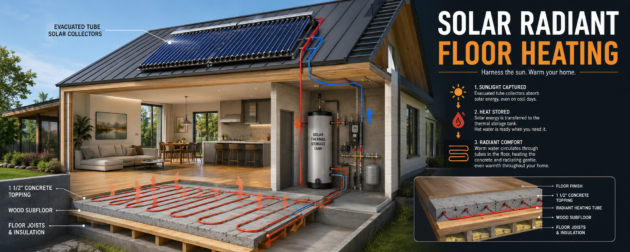
Collectors on the roof heat a fluid, which carries the heat to a storage tank with internal heat exchangers; the radiant floor pulls warm water back out. Direct, efficient at turning sunlight into heat, and a natural match because radiant runs at low temperatures. The catch: it makes heat only when the sun shines, and it needs roof plumbing and a glycol loop.
Path 2: PV + heat pump (make power)
PV panels make electricity; an air-to-water heat pump turns that power into warm water for a buffer tank that feeds the floor. No roof plumbing, no glycol, and the electricity can offset your whole bill, run other loads, or feed the grid. The heat pump does the heavy lifting on the coldest days when solar thermal would be struggling.
The plain-English overview – components, what it costs, whether solar is worth it at all – lives on solar radiant floor heating. This page is the part where you actually choose between the two. For the heat-pump side of things, see hydronic heating.
The Ontario winter problem (this is the crux)
Here’s the uncomfortable truth that decides most of these projects: your heating demand peaks exactly when solar output collapses. December and January bring the highest heat loss and the least sun, plus short days and snow on the panels. A solar thermal array sized to do real work in deep winter will then dump a surplus in summer when you don’t need floor heat at all. That mismatch is why, in much of Ontario’s limited-winter-sun climate, it’s often more practical – and frequently more cost-effective – to run an efficient heat pump on PV power than to feed the floor directly with solar thermal. PV keeps producing useful electricity on cold clear days, and a heat pump multiplies it into several units of heat. Solar thermal still earns its keep where you have strong exposure and a big domestic-hot-water or pool load to soak up the summer surplus.
Collector types: flat plate vs evacuated tube
If you do go solar thermal in Ontario, the collector choice matters more here than it would in a mild climate, because our winters punish heat loss.
| Flat plate | Evacuated tube | |
|---|---|---|
| Cold-climate output | Drops off fast; collects little heat in very cold weather | Holds output well – the vacuum cuts heat loss |
| Peak temperature | About 170-180 F | 250 F and up |
| Cost & maintenance | Cheaper, durable, simple | Higher cost; individual tubes can be replaced |
| Freeze behaviour (glycol loop) | Needs the glycol loop for protection | Naturally freeze-resistant in an indirect loop |
| Best fit | Mild climates, summer/DHW-heavy loads, tight budgets | Cold Ontario winters, space-limited roofs, higher temps |
The cold-climate reality: in genuinely cold weather a flat-plate collector can gather very little heat, while an evacuated tube keeps working because each tube is sealed under vacuum – the same reason a thermos keeps coffee hot. In a cool climate you might need two or three flat plates to match one evacuated-tube collector through winter. So for an Ontario home where the point is winter heat, evacuated tube usually wins; for a place where the solar is mostly summer domestic hot water or a pool, flat plate’s lower price can make more sense.
Why you need a glycol loop in Ontario
You cannot run plain water through rooftop collectors in this climate – one cold night and the loop freezes and splits. So an Ontario solar thermal system is almost always an indirect (closed) loop: a food-grade propylene-glycol antifreeze mix circulates between the collectors and a heat exchanger in the storage tank, and the building’s potable and radiant water never go up to the roof. The glycol loop is your freeze insurance, and it’s one more reason evacuated tubes shine here – their low heat loss makes the indirect loop more freeze-tolerant and more productive on cold, clear days.
The modern setup: PV-driven air-to-water heat pump
The configuration we see winning more often in efficient Ontario homes skips rooftop plumbing entirely. PV panels make electricity, an air-to-water heat pump uses it to warm water into a buffer/thermal-storage tank, and the radiant floor draws from the tank – storing heat when demand is low and releasing it when the house calls. It pairs beautifully with radiant because radiant wants low water temperatures, which is exactly where a heat pump is most efficient. The PV doesn’t have to power the heat pump in real time, either: any electricity it makes offsets your bill, and the grid acts as your battery unless you choose to add real ones. The trade-offs, sizing, and where a heat pump fits among boilers and combis are all on hydronic heating.
Off-grid and battery considerations
Going fully off-grid with radiant is the hardest version of this. Heating is a big, sustained winter load, and batteries that can carry a heat pump through a dark, cold stretch are expensive. Most “solar” radiant homes in Ontario stay grid-tied: the panels offset consumption, the grid covers the gaps, and a conventional backup handles the coldest days. If true off-grid is the goal, the design leans on a tight, low-load envelope (ICF helps a lot here), generous storage, and an honest backup such as a wood stove or propane – solar shrinks the load, it rarely carries January alone.
Thermal or PV – the load decides, and the load is one number.
Get the heat-loss before you choose a solar path
Whether solar thermal or a PV-driven heat pump makes sense – and how big either needs to be – falls out of your home’s heat loss. A CSA F280-12 heat-loss calculation sizes the system, sets the radiant water temperatures, and is the BCIN-stamped paperwork your Ontario permit requires. Upload your plan and our engineer emails you a price. More: do I need a heat-loss calculation?
Sizing, summer surplus, and the backup you still need
Two rules carry over from any solar radiant design. Size for winter, plan for summer: an array big enough to matter in January overproduces in July, so route that surplus to domestic hot water or a pool rather than letting it cook the tank. And always include a backup heat source – a combi or boiler, a heat pump, electric resistance, or a wood stove – because in an Ontario winter solar is an offset, not a guarantee. Realistically, solar can offset on the order of 30% or more of the fuel a conventional forced-air system would burn; the rest is the envelope and the backup doing their jobs. The full sizing and cost picture is on solar radiant floor heating, with per-square-foot radiant numbers on the Ontario cost page.
Get a solar radiant heating quote
We’ve designed and installed radiant – solar thermal and PV-plus-heat-pump – in our own ICF homes for 30+ years. Tell us about your project and we’ll call you back, usually within one business day, with a real plan and price. No cost, no obligation.
OK
You’re on the list!
Thanks – we’ll call you within one business day to talk through your solar radiant project and pricing.
Stuck between solar thermal and PV? Get a one-on-one consult.
Collector choice, glycol loops, PV-plus-heat-pump sizing, off-grid feasibility, or a second opinion on a quote. We scope it on a quick call and send a secure payment link – you only pay once you know what you’re getting.
Building new? The HST rebate can cover a big slice
If this radiant system is going into a new build, that home likely qualifies for Ontario’s enhanced HST rebate – up to $130,000 back if your build contract is signed before the deadline. Check your number before you commit.
Ontario HST Rebate | Deadline April 1, 2027
You Could Lose Up To $106,000 If You Don’t Start Before April 2027
Ontario’s enhanced HST rebate puts up to $130,000 back in a new-home builder’s pocket – but only if your build contract is signed before April 1, 2027. Miss that window and you fall back to the standard $24,000 rebate.
$0
Contract signed before Apr 1, 2027
$24,000
Signed after the deadline
$900,000
Miss the deadline and you forfeit
$0
Estimate based on Ontario’s 2026 enhanced HST rebate (Bill 114). Final eligibility is confirmed by a licensed rebate specialist – that’s what the free check is for. Full HST rebate details
Solar radiant pairs best with ICF
Whether you go thermal or PV-plus-heat-pump, the single biggest lever is the envelope. An ICF home loses far less heat, so a smaller array and backup carry more of the load - and a bigger share of your heat comes free. It's the combination we build into our own homes. See what ICF is, browse our ICF house plans (every one offered with the ICF + radiant package), run the ICF cost calculator, or check code with the OBC Code Navigator.
All radiant guides
Radiant & in-floor hub
Radiant heating design
Simcoe County
Basement radiant
Radiant cost in Ontario
Electric vs hydronic
Radiant vs forced air
Radiant floor heating 101
In-floor systems & methods
Hydronic heating
Solar radiant heating
Radiant + flooring
Will radiant heat my house?
Do I need a heat-loss calc?
Heated garage & shop floors
Radiant floor cooling
Heat-loss calculator
Solar energy for radiant floor heating: frequently asked questions
Solar thermal or solar PV for radiant heating - which is better in Ontario?
It depends on your exposure and load, but in much of Ontario's limited-winter-sun climate, PV powering an efficient air-to-water heat pump is often the more practical and cost-effective route, because PV keeps producing on cold clear days and the heat pump multiplies that power into heat. Solar thermal direct is strong where you have excellent south exposure and a big domestic-hot-water or pool load to absorb the summer surplus. Either way, a backup heat source is part of the design.
Can solar panels (PV) run radiant floor heating?
Yes - indirectly. PV panels make electricity, which runs an air-to-water heat pump that warms water into a buffer tank, and the radiant floor draws from that tank. It pairs well because radiant wants low water temperatures, exactly where a heat pump is efficient. The PV doesn't have to power the heat pump in real time; grid-tied, the electricity it makes simply offsets your bill.
Flat-plate or evacuated-tube collectors for Ontario?
For winter heat in a cold climate, evacuated tube generally wins - each tube is sealed under vacuum, so it loses far less heat and keeps producing when a flat plate would gather almost nothing. Flat plate is cheaper, durable, and simple, and makes sense where the solar is mostly summer domestic hot water or a pool. In a cool climate you might need two or three flat plates to match one evacuated-tube collector through winter.
Do solar thermal collectors work in an Ontario winter?
They work, but output drops in deep winter just as your heating demand peaks, and snow on the collectors makes it worse. Evacuated tubes hold up better than flat plates in the cold. The honest planning view: solar is an offset that shrinks your winter fuel bill, not a system that carries January on its own - which is why a backup is always included.
Why do I need a glycol loop with solar collectors?
Because plain water in rooftop collectors will freeze and split on a cold Ontario night. The system uses an indirect closed loop: a food-grade propylene-glycol antifreeze circulates between the collectors and a heat exchanger in the storage tank, so your potable and radiant water never go up to the roof. The glycol loop is the freeze protection that makes rooftop solar viable here.
What is a solar-assisted heat pump for radiant?
It's the PV route: solar electricity (or just the grid) runs an air-to-water heat pump that charges a thermal-storage tank, and the radiant floor pulls heat from the tank - storing energy when demand is low and releasing it when the house calls. Because radiant runs at low water temperatures, the heat pump operates in its most efficient range, and PV offsets the electricity it uses.
Do I still need a backup heat source?
Yes. In an Ontario winter, solar - thermal or PV - is an offset, not a guarantee, so the design always includes a backup: a combi or boiler, a heat pump, electric resistance, or a wood stove for the coldest, darkest stretches. Solar shrinks the fuel bill; the backup secures your comfort.
Can a solar radiant system run off-grid?
It can, but heating is a large, sustained winter load and the batteries to carry a heat pump through dark, cold spells are expensive. Most solar radiant homes in Ontario stay grid-tied: the panels offset consumption, the grid covers the gaps, and a conventional backup handles the coldest days. True off-grid leans hard on a tight, low-load envelope (ICF helps), generous storage, and an honest backup.
How much can solar offset my radiant heating fuel?
As a general planning figure, a well-sized solar system can offset on the order of 30% or more of the fuel a conventional forced-air system would burn - more in a tight, well-insulated home with good exposure, less in a leaky one or a poor solar site. The envelope and the backup do the rest, which is exactly why the heat-loss calculation comes first.
Is solar thermal or PV cheaper for radiant?
Solar thermal has lower equipment cost for the collector side but adds rooftop plumbing, a glycol loop, and a specialized tank. PV has dropped a lot in price and avoids roof plumbing, but you're also buying the heat pump. The cleaner comparison is total installed cost and what each does for you year-round - PV electricity offsets your whole bill, while solar-thermal heat mainly offsets heating and hot water. Get both priced on the same scope, and let your heat-loss number size them.
Note: general guidance for Ontario homeowners and builders, not a quote. Solar output and the right thermal-vs-PV choice depend on your roof, climate exposure, load, and heat-loss design.
Latest posts
Fresh guides, calculators & real-world advice
More from BuildersOntario - scroll to explore.
Loading latest posts...
Tip: shift + mousewheel works great
Sizing a radiant floor? The design starts with the heat loss.
Tubing spacing, water temperature and boiler size all come from a room-by-room CSA F280 calculation. Ontario Heat Loss delivers certified calculations and complete hydronic designs in 48 hours.
Certified CSA F280 heat loss report — $395, 48h · Full HVAC design & mechanical drawings — $695